Wednesday, 1 March 2017

Public service anonymity is dead, long live public service anonymity


by Kent AitkenRSS / cpsrenewalFacebook / cpsrenewalLinkedIn / Kent Aitkentwitter / kentdaitkengovloop / KentAitken

Very long read. Here's a print-friendly version. - Kent


Here’s my starting point:

  1. Public service anonymity is dying, and was probably always more dead than you’d think
  2. This will come with both upsides and downsides, and probably more of the latter than you’d think
  3. We should probably take steps to fill the current policy and culture vacuum

I find the concept of public service anonymity fascinating. That is, the convention that public servants work behind the scenes and should publicly receive neither blame nor praise for their work. It’s tied to the idea of Ministerial responsibility, for which we’ll turn to the Library of Parliament:

The essence of the theory of ministerial responsibility can be simply stated: ministers are responsible for the conduct of their departments. Reality, as C.E.S. Franks comments, "is much more complex and less satisfying than the theory."

Shielded from the publicity and politics of publicly accounting for outcomes, public servants can therefore provide honest and impartial advice to their Ministers, over a long career,  with the public’s trust to do so. They are "formally accountable internally - and only internally - to the ministers they serve." More on this later.

Public servants are clearly not anonymous in the general sense of the word. What we might call “public service Twitter” may not be obvious to those outside that bubble, but there’s an active community of public servants talking about government daily. But there are other trends:

  • Public servants’ emails, analyses, organizational charts, and and job descriptions are all subject to Access to Information laws
  • Anyone can look up who sits where in any government organization through the Government Electronic Directory Services
  • Public servants deliver speeches and presentations to public audiences

Examples like that are a part of, but not a full accounting for, the pressures against the anonymity convention. Within the concept, we can start making sub-divisions. Talking publicly about research, or trends within a field, is different from talking about one’s job and work. Talking about policy options pre-Cabinet is different from talking about implementation. And the general use of the term anonymity (the public not knowing who you are) is different from the meaning here: being held to account for policy advice and successes or failures: that is, answerability. Likewise, where a mistake is made in the bureaucracy, the Minister accounts for it, is responsible, but is understood not to be personally at fault. The end result is that public servants are theoretically kept out of the limelight.

There is, as you might imagine, a lot of gray area.

This post is going to be a fairly lengthy exploration of the concept, and I’m intending it as a conversation starter. I’d love feedback, challenges, or conversations. If it’s an interesting discussion but you’re not comfortable discussing it publicly, please feel free to re-post behind government firewalls and discuss there... while remembering, of course, that it’s still subject to Access to Information laws.

Origin stories


Where did this all come from, and why are we talking about public service anonymity anyway? You could be forgiven for thinking that it’s a meme, and only exists because public administration academics, journalists, and public servants keep talking about it. The concept doesn’t appear in, for instance, the Values and Ethics Code for the Public Sector.

We could skip to more recent history, but evidently such a piece wouldn’t be complete without mentioning Northcote-Trevelyan.

In 1853 the British Chancellor of the Exchequer William Gladstone (roughly equivalent to a combined Minister of Finance and President of the Treasury Board) commissioned a report on how the civil service should work. The resulting Northcote-Trevelyan report led to the creation of Her Majesty’s Civil Service, and set out many of the principles on which the UK (and therefore Canadian, though somewhat later) civil service operates: professional, non-partisan, and merit-based.

However, the flipside of merit is the reduction in patronage and politically-driven appointments, which meant a separation from political circles. Eventually this became a convention that made its way to Canada as well, cemented in 1918 through the Civil Service Act.

The convention got an in-depth treatment in 1995/1996 by the Task Force on Public Service Values and Ethics established by the Clerk of the Privy Council, in the form of  a report called A Strong Foundation.

That report refers to “discretion, anonymity, impartiality, and loyalty” as public service values, but also notes the fuzzy origins: “Rightly or wrongly, many public servants appear to believe that public service had always been based on an implicit bargain.” Donald Savoie characterizes this bargain as, essentially, less pay at senior-most levels and no public praise in exchange for a steady, anonymous career.

I’ll truncate and summarize the Strong Foundation points quickly, but they’re somewhat required reading for this topic. They pegged this as an emerging trend over two decades ago:

“Many public servants assume, rightly or wrongly, that the principles governing the relationships between themselves, ministers and Parliament are shifting, but they do not yet understand what the new principles are to be… [including] that the concepts of ministerial responsibility and public servant anonymity are under threat and lightly treated, and that this is undermining the foundations of public service…

[W]e do not see any reason, at this point, why it could not or should not evolve in ways that are largely consistent with the vital or essential principles of the past.”

As a side note, this is not quite a universal take, and some observers think the shift is more recent. In 2009 The Globe and Mail wrote “Few Canadians have heard of Kevin Lynch, which is as it should be with a member of Canada’s permanent public service.” Dennis Grube studied public speeches made by Clerks of the Privy Council - Lynch’s former position - as a new phenomenon in a 2013 paper.

Have the principles shifted? Let’s set aside Ministerial accountability and look at just anonymity. In 2013 Destination 2020, the most recent report on public sector renewal, called for “An open and networked environment that engages citizens and partners for the public good.” In 2015 a piece written by the former Clerk of the Privy Council included that “Canada needs policy-makers who are more networked, open and collaborative: our policy community needs to be set to ”open” by default.”

The devil, as always, is in the details; open doesn’t necessarily mean always, or two-way, or from every individual employee, or to the public. But I think it’s fair to suggest that the signposts are pointing in a particular direction.

I do not think, however, that the understanding and conventions on conduct, values, ethics, or culture have evolved in lockstep. This is territory for which there’s no map.

Government in 2017: from anonymous to open, networked, and anxious


We could ask whether the environment is changing - open government, digital media, collaboration, etc. - but I’d like to back up even a bit further and return to an opening line: public service anonymity was probably always more dead than you’d think.

It’s easy to point at Twitter and say that “anonymity is dying,” but it’s really hard to distinguish between genuinely new trends and trends that are merely new to the observer.

Public servants on Twitter is a novel behaviour, of course, because Twitter didn’t exist until 2006. However, it’s hard to say what the state of “collaboration with professional communities, stakeholders, and partners” would be in the absence of a given platform or tool. It’s likely that at least a portion of the weight we’re assigning this trend is because the digital age has revealed to us attitudes and behaviours that were, in part, always there. For example:

  • Public servants presented to external audiences before Twitter
  • Grube notes that public servants are increasingly called to Parliamentary committee hearings
  • The memoirs of Former Clerk of the Privy Council Gordon Robertson make it clear that people knew the senior public service community in the 1940s and 1950s
  • We could consider the “street-level bureaucrats” that Michael Lipsky studied in his 1980 book: front-line service delivery officials with a lot of leeway and little oversight in their interactions with citizens
  • Non-executives are named in media stories born from requests through the thirty-year-old Access to Information law

Anonymity was never a perfect arrangement, but the limits - and the behaviours that resulted - were more hidden from observers. Anonymity was always a more fragile and conflicted convention than we might admit, but I think it’s inarguable that the scope and and speed of the shift is increasing.

Anonymity, meet reality


Here’s a disjointed set of cases to consider.

First, the decline of anonymity is tied to larger shifts in governance practices. Starting in 2005, academics started painting a portrait of the shift from New Public Management (NPM) to Digital-Era Governance, which was as much built on the lessons learned from decades of NPM as it was from new digital possibilities. Some of the themes start to demand collaboration and interaction with actors outside government, beyond what’s possible through procurement, the political layer, or the creation of arm’s-length agencies:

  • Delivery-level joined-up governance
  • Client-based or needs-based reorganization
  • Co-production of services, especially in behavioural public policy (‘nudge’) fields
  • Citizens testimonials as substitutes for central regulation
  • Open book government and citizen surveillance as substitutes for central audit
  • Development of ‘social web’ processes within online government, and field services

Next: I’ve heard that social media is a thing. Almost two thirds of Canadians not only have accounts but log in at least once a month. While there’s a wide range of approaches to social media - attributed versus anonymous, professional versus personal, consuming versus contributing - it’s common to have a profile that is uniquely identifiable that references one’s professional position. LinkedIn is a good marker because it’s almost invariably both attributable and professional. I can find stats saying that 12% and 20% of Canadians use it - which includes public servants listing their roles, duties, and accomplishments.

Which is particularly important for knowledge workers, and as per the Government of Canada, “changes are occurring in the Public Service workforce with a shift towards more knowledge workers.” Having a digital presence is increasingly not only a benefit but an imperative for professional advancement. At its starkest, government simply couldn’t recruit new digital communications talent if those people couldn’t have a digital presence and portfolio, as that would mean nearly ruling out private sector and not-for-profit work later in careers.

Likewise, government digital teams are a noticeable outlier for both their level of public presence and their propensity to push against what used to be limits for how public servants talk about their work. The culture may be a smidge outside government norms:

[Department of Defence digital lead Chris] Lynch was originally recruited to the USDS by [US CTO Todd] Park. “I swear to God, I had no fucking clue who Todd Park was,” Lynch recalls. “Then I got this email from the White House. So then I looked and I was like, Oh shit, Todd is the CTO of the country!”

Basically, partially because of the “tour of duty” approach to bringing people into government as a sojourn from longer private sector careers, and partially because of the need for top talent, the rules were bent for digital. For example: The White House Gives Up on Making Coders Dress Like Adults.

The UK digital team started their blog in 2010 and started attributing posts to team members in 2011. (It took us until 2016 to get there.)  Notably, the common maxims of those digital teams, expressed through those blogs, are often essentially a (small-p) policy shift. Particularly in the case of calls to use open source software where possible.

The digital talent example also hints at the reality governments will face creating a “porous” public service with regular movement between public and private sectors, which is an increasingly common goal. The top talent in a field will have a public record of statements, presentations,  blogs, and social media expressing their views from their time outside the public sector. An interesting characteristic of the internet is that content has two audiences: the current, intended audience and an infinitely large hypothetical, unpredictable, future audience.

For career public servants, the Government of Canada’s 2013 Policy on Acceptable Network and Device Use was explicit about what employees could do publicly, including:

  • Participate in a video or audio conference with colleagues or clients from other organizations or jurisdictions through tools such as Skype or Google Hangouts;
  • Develop and share code repositories in collaboration with departments, other jurisdictions and private sector organizations via code sharing tools such as GitHub;
  • Maintain an up-to-date profile on professional networking sites such as LinkedIn;
  • Read, contribute to, or edit articles in work-related wikis, online forums or discussion groups;
  • Discuss professional issues or participate in professional associations via online forums or social networking sites

Leadership and policy is changing too. In the Government of Canada, a handful of high-priority government-wide initiatives (Blueprint 2020 most notably) have directly solicited comments about public servants’ work - and done so in public spheres. The community-led #LeadersGC tweet chats, while unofficial, get as close to an official blessing as possible through the participation of senior executives. In these cases and others, public servants get rewarded (or their wrists go un-slapped) for what could be seen as breaches of the anonymity convention far more often than they get training or reminders about what it means to be a professional in the public service.

Meanwhile, public service executives have been regularly named in media stories about the Phoenix pay system, and people have been putting public pressure on whether or not they receive performance bonuses. This goes beyond anonymity and well into answerability and accountability.

Why should we care?


Taking stock: the principle of anonymity exists precisely because it has value for public sector governance in Canada. But it never worked perfectly, and the pressures weighing on that convention are increasing. Which means what, exactly? As per Grube, again:

“I argue that the reason these changes matter is because the traditional anonymity of civil servants is linked in important ways to the impartiality of the civil service. To dispense with the former is to endanger the latter in ways that re-shape the core role of civil service leaders in a Westminster system.”

Then, quoting Peter Aucoin:

“The anonymity of public servants, as invisible to parliament or the public, disappeared some time ago…[M]inisters, sometimes explicitly, usually implicitly, expect those public servants who are seen and heard in countless public forums to support government policy, that is, to go beyond mere description and explanation…[W]hen the public value of what the government is doing is disputed, they expect public servants to rise to the challenge. To the degree that ministers can expect public servants to do so without instruction, the culture is infested with the norm of promiscuous partisanship.”

There’s a range of ways public servants can talk about government. Lindquist and Rasmussen put the ends of the spectrum as “neutral competence” and “political instrument.” Alternatively, consider these differences, taking public sector science as an example:

  • “There were X number of fish in the Fraser River in 2012 and Y number in 2013.”
  • “There were X number of fish in the Fraser River in 2012 and Y number in 2013, and the impacts will be Q.”
  • “There were X number of fish in the Fraser River in 2012 and Y number in 2013, and to correct this trend government could do Z.”
  • “There were X number of fish in the Fraser River in 2012 and Y number in 2013, and government should do Z.”

Subtle but important.

Yet, Grube writes that the core of it isn’t even “promiscuous partisanship,” but just the possibility of “perceptions of partisanship,” which he says only anonymity can solve. Any public explanation of programs or policies, however factual, may sound like support. Which is also true for social media: a public servant amplifying official government channels or spreading the word about events (I hesitate to use the word “promoting”) is likely going to be conflated with supporting that material. And on the flip side, public servants are very limited by the Values and Ethics Code in publicly addressing challenges in implementation, or expressing empathy towards affected stakeholders.

Grube concludes that “If governments are moving towards expecting civil servants to play a more public role, then some reconsideration of what we expect of administrative leaders is required. Westminster tradition needs to catch up with the new realities of practice and evolve some conventions that allow civil servants to fulfill their public roles without being targeted with allegations of partisanship.”

I’d suggest that the “more public role” exacerbates the issue, but barely matters. Government has to reconsider anonymity and the public service’s ability to provide fearless advice regardless. Cabinet documents are still held in confidence, but it’s not hard to piece together the advice to government from the ecosystem of inputs, and people outside government now know far more about what’s happening inside government: Access to Information requests have increased by 3,000% since the law was passed: from 2,229 in 1984-85 to 68,193 per year in 2014-15. Requests are currently increasing at roughly 13% per year.

I’d also suggest that governments don’t have to wonder whether they “[expect] civil servants to play a more public role.” I’ll invoke the argument from inevitability: whether it’s public servants being officially sent out to events as representatives or simply the combined portrait of their public activities, public service anonymity is good and dead. To resuscitate it, the entire contract for public service professionalism would have to be rewritten for the modern age, and very principled lines around public statements drawn and enforced. Which would have to be for both personal or professional contexts; the line between the two is disappearing.

And, while this may sound unlikely - particularly coming from me - I think that should be on the table.

But as it stands we’re in a bit of a policy vacuum, and it’s easy to imagine downsides:

  • Actors in the ecosystem could put pressure on one another to “not put that in writing” and hamper fearless advice
  • Public servants could paint themselves into corners through politically benign public statements that get viewed as partisan by observers
  • The impartiality of the public service could come into question (more than it already is) if advice is seen to change between political transitions
  • Public servants could asymmetrically build both relationships with, or understandings of, different stakeholder communities (e.g., what if the Director of a policy shop has a relationship with Google but not Facebook? What if they gain insight into stakeholders’ needs but they’re only connected to an unrepresentative sample of stakeholders?)

And let’s be honest, the word “could” is doing a lot of work in those bullets. For instance, research from South America has shown that transparency initiatives do indeed make officials more reluctant to share information.

So anonymity is dead, it’s going to cause some issues for the public service’s ability to provide advice to Ministers, and we should probably re-professionalize the public service in a new context and put some serious legwork into policies, principles, cultures, and training: to protect both the public service as an institution from perceptions of partisanship, and to protect public servants from pressure against fearless advice.

No individual will ruin the standing of the public service as a politically neutral, professional institution. But it could happen as death by a thousand cuts, a slow culture and perception shift driven by thousands of actors exploring an increasingly public world - and with many more citizens and journalists noticing that exploration. Which also means that it’s a tragedy in the commons situation, and no one actor has a reason to change behaviour. Particularly when a digital presence can help people’s careers. And the public service, as an organization, rarely drives people’s training and education; it’s mostly driven by individual employees, which makes it hard to reinforce messaging on values and ethics repeatedly throughout careers.

The good news


So you weren’t planning to renovate your kitchen, but some pipes froze and you have to rip out the counters anyway. Might as build it the way you want it this time. As for the public service contract, we should at least consider if there are changes we want to make, and I’ll suggest some possible benefits.

One, if the nature of accountability is changing, we could reconsider the relationship between accountability, responsibility, authority, and expertise. Right now we hold Ministers accountable for the minutia and complexity of vast portfolios, including things for which they cannot be reasonably expected to have control or expertise. Likewise, we make public servants with subject matter expertise responsible for activities over which they have no authority. (And somehow measure their performance on that.)

I cannot stress enough how important this concept is: that we hold Ministers accountable for the minutia and complexity of vast portfolios. Consider:

The anonymity convention was born (roughly, subject to debate) in 1854.

Skipping ahead almost a century, in 1937 the entire Ottawa contingent of the External Affairs department (now Global Affairs Canada) was eleven officers. In 1939 there were only six missions abroad. Now it’s 5,890 employees.

Similarly, the federal public service was 46,000 people in 1939. Today it’s more like 260,000 people.

And compared to the mail-based eleven-person External Affairs of 1937, modern governments have several orders of magnitude more contact points with stakeholders and citizens. We recognize the complexity of issues and the need for collaboration: both of which require significant time investments and on-the-ground, user-centric knowledge. We designed public institutions around a long-standing belief that public policy issues were far simpler than they are, and for policy shops, meaningful connections to stakeholder communities are a vital source of insight, understanding, and reality about how policy decisions affect people. And they’re likely to be two-way connections. It seems reasonable to at least consider where individual accountability might meet the original reasons for anonymity halfway. As the head of the UK Government Digital Service, Mike Bracken, put it:

[The Permanent Secretary at the Department of Business] says that the best way to get impartial advice is to ask an impartial adviser, if there is such a thing. These days, sadly, those impartial advisers don’t know enough. Advice must come from the doers – the people at the coal face that understand the shortcomings of their services and who are brimming with ideas for how to make them better.

This, in my view, is the response to what I’d consider the best argument for maintaining anonymity and bolstering the primacy of the Minister as the person responsible for a department. To suggest a bigger role for the public service could easily be conceit, where Ministers are the democratically legitimate representatives and, of course, should be speaking for the portfolio and setting policy direction. I agree, but I also humbly submit that to consider that principle in an absolute form in 2017 is somewhere between nuts and impossible.

Two, there are benefits that will flow from the move towards open governance and citizen engagement that are simply in conflict with the ideas of anonymity. Governments have been consulting extensively online and in-person. So for starters, we can throw anonymity straight out the window when a public servant is representing government by sitting in a room with stakeholders; they’re going to associate that person with the eventual policy decision by default. As well, the value proposition for participants is in knowing that they’re giving their input to someone who can do something about it. There’s no engagement without a degree of authority, and no reason for trust without a degree of accountability.

Third, governments have long relied on their authority in communications, perhaps at the expense of credibility; telling, not showing. The exact phrase “The government is committed to” gets 1,200,000 results in Google. The idea is that if it came from government, people should trust it. Yet what we’re seeing is a decades-long decline in trust in government, and Canada was an outlier in the 2017 Edelman trust barometer: a -10 percentage point drop from 2016. This is also a tragedy in the commons: governments should be more forthcoming, credible, and honest in their communications and comments to media, but no individual should. One misstep that hurts the government outweighs a hundred moments where an honest interaction with a journalist would add quality and context to a story. As Deloitte’s Bill Eggers puts it:

“Bureaucracies tend to punish failure, which is memorable, and reward mediocrity, which doesn't produce a metric you can pin to a file.”

The current construct also means that governments can’t actually ever use social media for anything than a broadcast channel. People interact with and have relationships with people, not governments. (See: Why Government Social Media Isn’t Social.)

Yet. As per Edelman: the most trusted source of information was the employees of governments and firms - on multiple topics.

It’s not like there won’t be downsides to pushing more authority to officials to interact with citizens and stakeholders. Too far, to some extent, that way madness lies. But the question should be on the table - largely because it's already happening, but without guidance.

So where does that leave us?


For those who currently have a public presence, and get benefit from it: don’t lose sight of the fact that this is not an unambiguous win for government writ large. There are risks both short and long term. The public service is built out of the collective expertise and experience of public servants - but also their relationships and biases. For better and worse.

Public service anonymity is dead, and perhaps always was. If so, it’s extra dead now.

We may be able to maintain the value - in particular, the ability of the public service to provide fearless advice - but there’s work involved. It will require a hard look at the public service contract and culture, and a legitimate effort to create and embed a new set of principles for public service that honour the professional, non-partisan role while being realistic about an unavoidably public public service. The good news is that there’s a lot of potential for better governance, if this is done well.

I dislike analyses that end with  “Governments have to think about X” rather than providing concrete recommendations. In this case, however, the issue is too fundamental to our democratic institutions. This cannot be meaningfully explored without elected officials, and so if pursued, it - anonymity, but within the larger question of accountability - would have to be a question for a commission, task force, or a Parliamentary Committee. My recommendation for this piece is that it should be. In the meantime, organizations' heads are responsible for making sure that their employees have an appropriate understanding of public service values.

Friday, 24 February 2017

An Outside Perspective on Government Email Etiquette


by Nick CharneyRSS / cpsrenewalFacebook / cpsrenewalLinkedIn / Nick Charneytwitter / nickcharneygovloop / nickcharneyGoogle+ / nickcharney

I got an email from a friend who is a "non-gov person who wants to remain anonymous" last week (exchange below, blogged with permission). Read until the end, if you are interested in following up, I'd be happy to connect you.

The only thing I would underscore from the comments below, is that we have yet to unlock the business intelligence locked away in our email traffic. Sure we have hierarchical organizations but a robust analysis of email traffic would likely yield a more accurate map of how information and tasks move through the system than or org charts ever would. That and our email culture / etiquette is generally horrible.

[ANON]

Subject: two observations from emailing with people in the GOC

You guys cc way too much. You receive an email and it’s like, “Who are all these people and why are they here??” Executives are impossible to pin down for meetings, and then sometimes don’t even attend despite everyone organizing around them. I have a lot of trouble believing they are that busy and their time so precious, as in, I’ve asked lawyers and execs in the private sector, who say that that kind of unavailability is just not a thing they would see. One day when I have time I seriously want to study the inefficiencies of government email and meeting scheduling.

Sorry – just needed to rant to a kindred spirit.

[CHARNEY]

Can I blog this anonymously or otherwise?

[ANON]

For sure. You can just say it was a non-gov person who wants to remain anonymous.

You can use content from the email if you want, as well.

It is actually shocking to observe the different email habits of government, which seem to have developed a life of their own, and are likely taken for granted as the norm now in the public service. But, as an outsider entering this bizarre world, it’s confusing and time consuming and seems wholly inefficient. I can only imagine the number of inboxes that are needlessly filled with excessive cc’ing. What do people do with these emails? What is the power dynamic and/or disorganization that leads to people thinking it’s a good idea to include people on an email as a default?

[CHARNEY]

Most ppl keep them as CYA / history if needed.

I delete them.

In my previous team we cut email by 3/4 and had a standing practice of if you needed something urgently call. Since changing teams it’s been tough to deal with the deluge.

Did you want to add anything to the content, i.e. make it a real post or would you rather me just comment in over top of it and use it as a quotation?

[ANON]

Feel free to quote me and add in your own analysis. The only thing I would add (which I’d like you to quote) is that we need to better study this empirically, to understand patterns of email traffic across the GC, to identify differences across teams (and the reasons why that’s the case – better management, less complex issues, more independent work, different demographics?), and to compare with other large bureaucratic orgs (I.e. Is this a public sector problem, or a large org problem?). I’d also like to run experiments where phone calls and IM are subbed for email and meetings, to test for efficiency gains. If anyone is interested in giving me access to the email traffic data that would let me conduct these studies, then I would be happy to be outed publicly, and maybe they can contact me via you.

Friday, 17 February 2017

Innovation: Design Process or Street Fight?


by Nick CharneyRSS / cpsrenewalFacebook / cpsrenewalLinkedIn / Nick Charneytwitter / nickcharneygovloop / nickcharneyGoogle+ / nickcharney

So last week Kent posted a long and detailed overview of public sector innovation that he had prepared as a response to an inquiry we received (See: Public Sector Innovation). The post prompted a series of comments as well as back channel conversations. My favorite comment had to be Blaise's, who said (emphasis mine):
"As a seasoned practitioner reading this, I still find this post so effing meta and portraying a grandiose version of innovation romanticism. You and I have spent countless days and nights, talking about this stuff while being on the wide spectrum of sobriety. In my opinion, I don't think this post or any other comes close of connecting to the actual reality of being knee deep this proverbial "sh!t". As someone who does this stuff for a living, your zone of influence is so minuscule and granular, and the continuous battle for the ever fleeting victory of success on the project level, is that even thinking about "changing the system" is implausible and counterproductive.

Here's the hard truth about practicing "innovation": You just end up finding what works in the moment, or you fail. End of story. There is no "tried and true" list of best practice, playbook, guide or singular method to do this; there's just a hell of a lot of sleepless nights, constantly thinking on your feet, loads of adaptation and and far more compromise than you would normally assume. I could go on forever on this subject, but I feel that that the honesty will be lost on this audience, and that it just isn't good for my overall sanity to dwell."

I agree. The public sector innovation discourse in town is far too meta (so is the digital governance discourse btw), everyone's sphere of influence is limited, and there is no tried and true approach to innovation.

Having recently moved from a team focused on policy design to one focused on program implementation I'd go one step further and add that innovation isn't simply the fancy d-school process that puts words on paper but the nasty street fight that brings them to life.

I've a number of observations about the fight worth noting:

  • there's a fundamental disconnect between the innovation discourse from the centre and the practical considerations of implementation in line departments
  • we wrongly expect traditional delivery mechanisms and standard operating procedures to deliver innovative policy solutions
  • even the sharp edges of fully approved "innovations" can be ground smooth through the iterative processes associated with implementation
  • not enough is done upfront to ensure that implementation is a consideration in the design phase and that implementation concerns and timelines are well understood
  • there's a lot of rent-seeking behavior masquerading as accountability
  • successful implementation requires key players to have a higher risk tolerance
  • we lack an internal service culture and its to our detriment
  • key enablers are often more concerned with enforcing rules from the centre rather than enabling the organization to achieve its mission
  • not everyone you come against is actually looking for a fight or know they are in one

In short, the public service discourse has really focused on the question of what innovation looks like. As the conversation becomes increasingly more granular I would expect we will turn more of our attention to the question of how. In other words, roll up your sleeves, the fight is just getting started.

Friday, 10 February 2017

Public sector innovation


by Kent AitkenRSS / cpsrenewalFacebook / cpsrenewalLinkedIn / Kent Aitkentwitter / kentdaitkengovloop / KentAitken


This post is a response to an email from a provincial government colleague, who asked for frameworks and models for organizational innovation. I, perhaps, got carried away; it's a little lengthy for a blog post (here's a print-friendly version). I'd like to consider it an evergreen draft for the time being, as I'm sure I'm missing major chunks or have the blinders on for parts; I welcome comments on the working document. - Kent

Introduction, and innovation defined


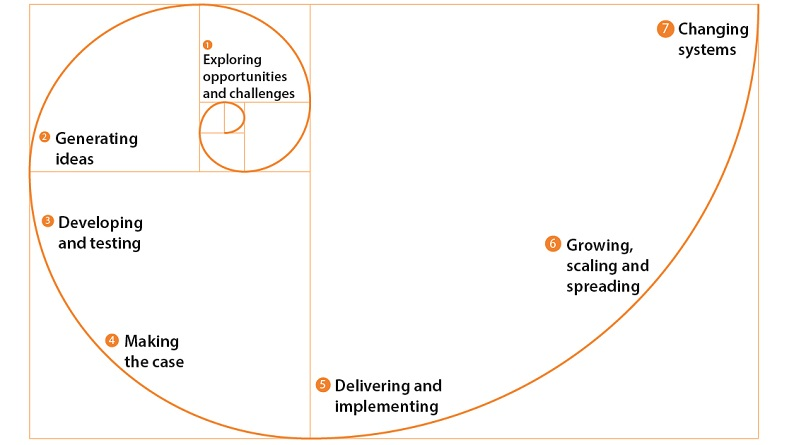
It’s important to make sure that everyone involved in your conversation about innovation is using roughly the same meaning; innovation gets overused to the point where it’s amorphous and meaningless. For this document, we mean change or novelty - so change to existing concepts, or new concepts - that gets implemented at scale and that creates value. Here’s NESTA’s model:


Source: NESTA

Two takeaways from the above: 1) good ideas that flop during testing aren’t innovations, but they are part of the innovation process; 2) “making the case” comes after testing.

It’s unhelpful to think of innovation as a skill, or of people as innovative. Innovation is a discipline that can be practiced, and some people practice it - by inclination, affinity, or opportunity - more than others, and to greater effect. It is better understood as a process than an event.

At the core of innovation is the idea of problem definition: know what problem you’re trying to solve. (Put differently, by Lincoln: “If I had five minutes to chop down a tree, I'd spend the first three sharpening my axe.”) This applies both to individual efforts towards innovation, and the meta-level question of innovation in government.

Turning to that problem: is the question fostering innovation? Encouraging innovation? Allowing innovation? Facilitating innovation? Supporting innovation? A combination of all of the above? Even a seemingly innocuous change in what verb we’re using reflects very different mental models about how innovation happens, and what stops it.

The discourse about public sector innovation jumps too quickly from problem to solution, from the question “Why aren’t we innovating more now?”. (For starters, sometimes you actually just don't need it.) If you do, the solution is rarely about simply connecting ideas to senior executives. Surface-level fixes to perceived innovation gaps are what lead to Dragon’s Dens to pitch “innovative ideas,” under-supported innovation labs, hackathons to “just see what people come up with,” and crowdsourcing for the sake of testing the idea of crowdsourcing.

The need for innovation


The concept that “government needs innovation” is a second-order condition, not a starting point. In reality, it’s that - sometimes, in context - particular programs are better served by innovation than a continuation of previous activities. In aggregate, this can turn into “government needs more innovation.” But the question can’t be “How do we innovate more?”, it has to be “How do we create a system whereby the status quo and valuable alternatives are on a level playing field, such that we can test and prove new ideas as reliably as we accept old ones?”

To back up slightly, let’s consider an arc of innovation that is both an analogy and a predecessor, that of telecommunications. We’ve gone from letter-writing to printing presses, telegraphs, telephones, the internet, and now to low-cost ubiquitous mobile connections. Every combination of one-to-one, one-to-a-select-few, one-to-many, public forums, with every combination of attributed or anonymous, for every combination of formats, all at a vanishingly small cost.

But here's the key: at one point, to communicate long-distance you had one option: handwriting a letter. Later, you had two: handwriting a letter, or paying to have something reproduced many times on a printing press. You didn't have to rely on a letter when it wasn't the best option. As more and more options became available, you could match your communications goal more precisely to different ways to achieve it.

Likewise, now we have a wider range of policy development approaches and policy instruments, which means there’s a greater chance that we can match the right approach to the right situation - if we can deploy those approaches without artificial barriers.

Some common approaches


We shouldn’t slip into mental models that restrict ourselves to an established catalog of “innovations.” However, it might be useful to consider the toolkit that public sector organizations are often drawing on in efforts to innovate. Some of these are focused on inputs, some on outputs (that is, how we approach decisions on what to do, versus what we actually do).


  • Foresight: systematic exploration of a range of plausible futures for a field, technology, policy area, often used in environmental scanning.
  • “Open” approaches: citizen and stakeholder engagement in service and policy design. This can be online deliberation, argument mapping, citizen’s panels, facilitated sessions, roundtables, or dozens of other methods. See: People and Participation, Designing Public Participation, and Dialogue by Design.
  • Participatory budgeting: overlaps with citizen engagement, but actually sets aside portions of government budgets for the citizens to decide on. Usually comes with a lot of work to create a fair and inclusive process, including web platforms to help people explore, debate, and vote on options, and to consider trade-offs and competing views.
  • Crowdsourcing: overlaps with citizen engagement, but let’s think of crowdsourcing as aiming for light inputs (ideas, concerns, suggestions, edits, votes) from many people. See: Crowdsourcing as a new tool.
  • Citizen science: creating platforms (toolkits, web platforms, games, physical infrastructure) that allow citizen inputs to government data collection: e.g., water and pH levels, photographs from standardized perspectives, star field mapping, protein folding. Here’s a cool example: Water Rangers.
  • Open data: releasing data created and collected by government to allow for third-party uses: social, economic, and academic research; platforms for access to government services and data;  business intelligence, etc.
  • Hackathons: collaborative problem-solving sessions, typically with technological solutions (but not always), that bring people together to define a problem then prototype and test minimally viable solutions, usually within 48 hours.  I helped organize and run this one.
  • Behavioural insights: generating and testing hypotheses from the behavioural psychology and behavioural economics literature to examine and optimize citizens’ interactions with governments (e.g., different language on letters from tax organizations leads to different response rates and times). Often paired with A/B testing two products/approaches to get authoritative data on which worked better. Worth it to skip straight past articles to the classic book on the topic.
  • Impact-based delivery models: can be partnership models, procurement, grants and contributions, or other funding models. Governments are increasingly exploring ways to get away from defining strict requirements for contracts, partnerships, or products up front and instead dispensing funds based on measurable impact with the approach left up to the third party. E.g,. the UK Social Value Act, social finance, pay-for-performance, or many public-private partnership governance models.
  • Challenge prizes: Posting monetary prizes for hard-to-solve problems that can be attempted by any individual or group. Groups attempt to solve problems on their own volition, with no promise of financial compensation. Often looking for technological or research proofs-of-concept, which governments can then purchase or pursue. Challenge.gov and the X-prize are the common examples.

That said: thinking in the above terms can be a trap. The process of deciding on action can often be boring. Good problem definition and ideas analysis can lead to re-using old solutions, or tweaking them only a little, and this has to be okay.

If a government policy team spends time making observations and conducting exit interviews with citizens using a particular service (an activity that could be equally called citizen engagement, behavioural insights, or design thinking) and makes minor policy changes based on that insight, is that innovation? If it creates value and they can scale it, sure.
On the flip side, for any private sector leap forward or emerging technology, there’s always someone waiting to say “How might we use [artificial intelligence/big data/data analytics/platform models/driverless cars/virtual reality/quantum computing] in government?” It’s worth musing about, but will only be worthwhile when that thinking happens to connect with a genuine problem - in a real-world program, policy, or service area - that needs solving.

Which means that none of the above approaches can be used in a vacuum: they need the connection to mandates, and the people who can understand and implement them.  It’s tempting to think that any of the above might be the perfect approach in a given situation, but unless the problem owner can and should deliver on them, it isn’t. That governments exist to deliver on mandates from elected officials is bizarrely easily forgettable.

It’s worth noting that many of the listed approaches are, in essence, just different ways to gain information and insight into stakeholders’ needs - that is, they can be routes to better problem definition and different ideas. They are ways to understand, and hopefully manage, complexity.

Internal innovation campaigns

On that note, a quick thought on internal innovation campaigns: that is, asking employees for ideas on how to improve the workplace or the organization's outputs. This is where there’s more control, less risk, and more room to play. However, if you open the floodgates and receive 1,000 ideas, you probably have to reject 995+ of them. You only have so much time and executive willpower, and some ideas will just be unfeasible. Consider only asking for ideas when management is genuinely ready to make change, and consider scoping out a theme area.

Many ideas will be predictable: Google's 20% time, skip-level meetings, development opportunities, 360 degree reviews, use [technology] for [activity], bring-your-own-device, buy [technology] for employees, telework, etc. If you’re interested in porting an established process into your organization, consider instead engaging employees on the details and implementation.

Some companies take internal innovation campaigns very seriously, and show more promise than my skeptical take. See: Why governments would never deploy Adobe’s Kickbox and why maybe they should.

Design thinking

Design thinking gets its own section, because if you solve for design thinking, you often end up solving for much of the above. It’s a structured process that helps organizations work through the problem definition, their own capacity, and the right approach - which might be innovative, or it might be boring.

These five steps are at the core of design thinking:

Source: IDEO

  1. Empathize: understand stakeholders and their needs, mindsets, challenges, and attitudes. Common techniques include interviews, observing people interacting with services, or group dialogue models. People can’t comprehend how powerful this is - and how much they were assuming - until they actually do this themselves.
  2. Define: once again, a focus on defining your problem really, really well.
  3. Ideate: generate ideas for how to solve the problem. Allowing different stakeholders into this process, having different perspectives mix, and using facilitation techniques to create space for creative thinking are all proven to generate more novel ideas than simply asking.
  4. Prototype: make anything (e.g., paper mock-ups of service interactions, lego buildings, rough websites, draft policies) that people can touch, explore, and react to. The act of building will help problem owners and idea generators understand how something will look, feel, and work in practice...
  5. ...but not as much as testing it will. Ideas from the previous stage will invariably be laden with assumptions, and when users - real, honest-to-goodness end users - start interacting with even a rough design, assumptions will be revealed, which will create opportunities to correct them. A sample size of five testers will reveal most of the critical failure points in, for example, a web interaction.

Design is also a discipline to practice, not a skill or an easily replicable set of steps. There are many, many ways to get the social science wrong at the empathize stage, generating false results, if you don’t know what you’re doing. Work with experienced designers while building your own capacity.

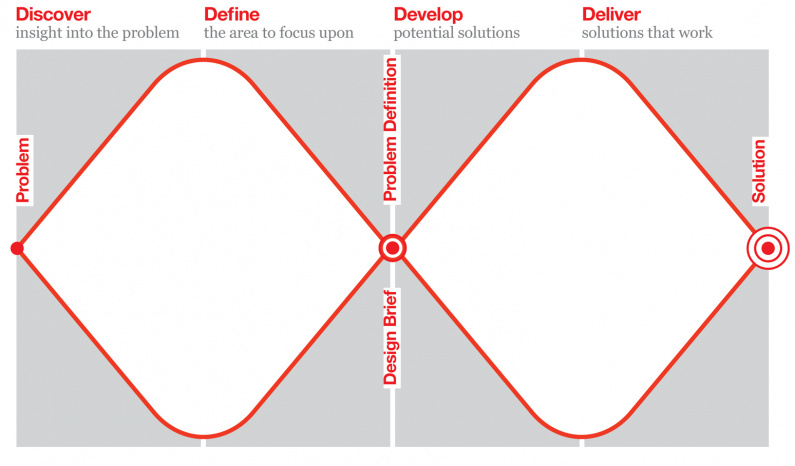
A related model is the “double diamond”, below. It describes the process of opening the conversation up to allow many considerations into the problem space, looking at many possible stakeholders and issues, before narrowing the focus down into a tight problem definition. Once that is done, the conversation opens back up to allow many possible solutions to surface, before deciding on one or some and taking steps to define and implement them.

Source: Rachel Reynard

Organizational models and strategies

It’s very different to talk about innovation in a localized, contextualized way (e.g., within a policy/program/service unit) and in an organizational, cross-government way. Individual units will innovate constantly, and the efforts may never bubble up to the government-wide radar. In many cases, the change won’t be called “innovative” - it’ll be born out of incremental change, financial pressures, or an opportunity to simply improve the program and it’ll just get called “better.”

The classic piece on innovation in private sector organizations found significant differences depending on where “innovation units” were positioned within the organizational structure. The long story short is that the wrong design and governance decisions can nearly guarantee failure.

However, organizational-level strategies can support individual, contextualized innovations in a few ways, including:

  1. Identifying and removing barriers
  2. Creating safe space for experimentation
  3. Providing training, tools, and resources

Barriers to new approaches

Get used to the idea of problem DNA. Every barrier and obstacle isn’t a homogenous element, it’s a unique combination of policy, risk, culture, understanding, time constraints, opportunity costs, process, communications, and other building blocks. Solving for one element rarely solves the problem.

Let’s return to the idea that, with new options for policy development and implementation, there’s a greater chance to match the right approach to the right situation. However, rules, policies, and processes were often designed before these options became available, so there are often barriers to their use, including hiring, mobility, contracting, procurement, and training. Creating flexibilities or exception processes in these systems is the blanket, one-size-fits-all approach to freeing up space to innovate. However, systematically taking steps to understand, and adjust for, the impact of these forces on how employees work is more effective - albeit more time-consuming and it requires more management commitment.

Safe spaces and innovation labs

An increasingly common approach is to create “innovation labs,” which are theoretically safe spaces that can bring people together to define problems and experiment with solutions.

For a proper, peer-reviewed definition:

“An innovation lab is a semi-autonomous organization that engages diverse participants—on a long-term basis—in open collaboration for the purpose of creating, elaborating, and prototyping radical solutions to pre-identified systemic challenges.”

These can be within organizations, at arms-length, or purely external as partners. They tend to be centres of expertise for design thinking, prototyping, facilitation, and other useful process skills. It is not that they are full of smart people (though they tend to be), it is that they are full of people with toolkits for organizational learning and for helping groups of people reveal and explore their collective wisdom and knowledge.

Labs tend to partner with business units once a need for change or exploration is identified. They essentially act as a combination of host, consultant, and partner for a policy/program/service development, implementation, or evaluation journey.

In governments, they tend to have dotted lines to senior executives to help create staffing, spending, and governance exemptions to allow for more agile, free-flowing operations. Which is important, as partnerships and collaboration within and outside the organization tend to define such labs.

NESTA has an innovation lab, MindLab is one of the longest-standing examples, and the MaRS Solutions Lab in Toronto has a helpful article on Social innovation labs: Top tips and common pitfalls. (There are many others, in and out of government. E.g., Alberta's CoLab, New Brunswick's NouLAB.)

Anecdotally, working with external labs (i.e., those outside of government) appears more likely to allow for the expertise, safe space, and transparency required. Expect that work with such labs will take a lot of time. The good news is it’s the appropriate amount of time for meaningful change, and the simpler solutions you would have arrived at through a half-hearted exploration would be incomplete, misleading, and ultimately less effective.

Central hubs, expertise, and resources

Organization-wide innovation strategies can also take steps to ensure the on-demand availability of training (e.g., on citizen engagement, facilitation, or data science), resources (including people and money), or expertise and advice.

Many skills central to the common toolkit of approaches are disciplines in and of themselves. They’re too specialized to fit into many permanent teams, and they’re called on at irregular intervals. For such skills, governments are creating central centres of expertise to house permanent specialist staff, who act as common resources to the rest of government: e.g., public engagement offices or behavioural insights units. The Government of Canada has a hub for a variety of approaches. They might operate on cost recovery or as free resources but with criteria for choosing the most high-impact projects to work with. If such specialists are creating value above and beyond their cost, capacity can be added over time (e..g, the UK Nudge unit).

Communities of practices are also useful for building capacity for skills for which external professional networks are few and far between. Ideally, managing these communities should be part of someone’s job, if not their full-time job. It creates connective tissue between experiments and pockets of knowledge scattered across organizations, which is particularly important for evolving, emerging fields of practice.

On levers

What levers for change do you have? Is your organization willing to make substantial changes to, for example, HR or contracting policy for the sake of an innovation agenda? It’s helpful to think through two lenses:

  1. What’s the best we can possibly do, given our current parameters?
  2. What possibilities would be available with certain strategic structural changes?

Levers for change may include:

  • Laws, policies, and regulations
  • Performance management frameworks
  • Executive/political commitment and champions
  • Internal and external communications
  • Training
  • Toolkits and resources
  • Hiring (or alternative models like short-term tours, fellowships, exchanges)
  • Procurement
  • Contracting
  • Organizational design, including the labs and hubs from above
  • Changes to processes (e.g., mandatory fields in spending proposals)
  • Common-use programs (e.g., centrally-led open data portals, citizen engagement tools, challenge prize platforms, web platforms that any department can use)

What to do next


    1. Make sure the most important stakeholders in your organization are talking about the same thing when they say “innovation.”
    2. Explore the current barriers, and don’t settle for surface-level answers (e.g., “risk aversion,” the most common, is a symptom, not a cause: what’s behind it?).
      1. Risk symptoms are most easily solved by 1) crisis or scrutiny that suddenly makes novel approaches more palatable than a publicly failing status quo, or 2) commitment and willpower, most often stemming from the political layer. For smaller-scale risks, commitment and willpower from senior executives can suffice. That is, they have to personally evangelize and clear obstacles for the change. Repeatedly and consistently.
    3. Agree on parameters: resources, level of commitment, available levers for change.
    4. Identify, or more likely enlist or partner with, people with deep expertise.
      1. Take a moment to consider how your organization knows expertise when it sees it, particularly for new, rapidly evolving, un-professionalized skills (e.g., there are no equivalents to Certified Accountants for public sector innovation).
      2. Find a role for the people in-house who want to be a part, and make sure it is neither above their heads nor meaningless (considering oneself innovative doesn’t mean one can lead this work; however, anyone who’s been pushing for these approaches will feel left out if external expertise is parachuted in).
    5. Create criteria for project intake and create ways for people to find you.
      1. There’s danger here, commonly referred to as “solutions looking for problems.” Ideally the innovation model is that everyone is focusing on their mandates, but with a light layer of constant learning, environmental awareness, and knowledge of the organization-wide innovation capacity for when it’s needed and would solve the problem better.
    6. Read and talk to people: there’s tons of great resources out there. The key is to learn how to find credible sources that best match your current context, and to triangulate between a few for each concept. Supplement with rapid evidence assessments.
    7. Write the future in pencil: experiment at both the project level and the meta, innovation-in-government level, learn, and change. If your “innovative project” has to be a success - that is, a project success, not an organizational learning success -  you’ve sold it wrong and your organization is thinking about it wrong.

    Reading

    Friday, 3 February 2017

    5 Insights for Policy Innovators


    by Nick CharneyRSS / cpsrenewalFacebook / cpsrenewalLinkedIn / Nick Charneytwitter / nickcharneygovloop / nickcharneyGoogle+ / nickcharney


    A couple of weeks ago I traveled down to Washington DC with Jason to discuss policy innovation with a number of different US thought leaders / organizations (e.g. Partnership for Public Service, 18F, the OPM Innovation Lab, US Digital Service, GovLoop/GovDelivery, NASA, Deloitte, IBM, etc.). We thought it would be good to share some of the key findings from our discussions.

    Spurring innovation can be as simple as turning an intentional blind eye

    John Kamensky from the IBM Centre for the Business of Government regaled us with stories of government reinvention labs under Vice-President Gore. The principle was simple enough, central authorities articulate a small set of goals -- e.g. be more client centric, cut red tape, improve client satisfaction -- and then turn an intentional blind eye to any activities that might bump against corporate policies in trying to achieve those goals. Not everyone had to do it, “reinventing labs” were simply teams that self selected, invoked the shield they were offered, and went about doing good better. He called it “using fairy dust to break bureaucratic mythologies” because it didn’t rely on any structural changes. Now he did say that this approach can ruffle feathers because it can undermine the hierarchy and/or the gatekeepers but it's also an incredibly simple way to facilitate greater innovation within the enterprise at relatively low cost, it's replicable within and across organizations, and boils down to giving civil servants license, a sense of agency, and a stronger connection to outcomes and organizational priorities.

    Innovation teams need partnership playbooks that articulate their terms

    Many of the US innovation teams have developed playbooks that clearly articulate what they do and don’t do, who they work with, and how others can access their services. This gives everyone a clear sense of what is in and out of scope as well as the cost of doing business with the team. My observation is that many of the Canadian innovation teams lack this sort of specificity. Being able to develope and then clearly articulate your value proposition and the service(s) you can provide to the department (and for that matter the management teams that allocate its scarce resources) is of the utmost importance for innovation teams, while the inability to do so is their achilles heel.

    If you want to attract projects to a department or agency’s innovation team, give it a budget that it can use to match funds

    One of the biggest differences we found was that many of the US innovation teams (and fellowship programs) have a budget that allows them to match the funds of the project proponent. This makes working with the lab (or bringing on a fellow) more attractive to the proponents. This seems to have resulted in some interesting optics whereby some see innovation teams as a subsidy to core business (access to warm bodies) while others see the prospects of successful collaborations that produce results much greater than the status quo (supercharge your ROI). Regardless of the opinions on the ground, these teams continue to be supported by senior civil servants and politicians..This approach does require that innovation teams have a strong management approach and a process through which they vet incoming projects -- meaning it’s very much linked to the notion of playbooks mentioned above.

    Storytelling

    All of our visits reinforced the importance of documenting the impact that innovation teams are having. Some teams had sent a team member across the country to visit collaborators on ground in order to document and celebrate their stories, some teams used their playbooks to ensure collaborators’ objectives were documented and outcomes recorded, other teams benefited from reporting requirements enshrined in legislation, and some teams adopted a culture of reporting out for its inherent value of sharing lessons learned and demonstrating what’s possible.

    Without this data, it’s difficult for a team to surface what they do exceptionally well and the conditions that need to be in play to do their best work (see playbooks, above), and it’s difficult to create a narrative that points, in real terms, to the impact.

    If you want to use money to drive innovation, active budget hold backs are always better than passive asks to carve out funds.

    Basically it’s really hard to force someone’s hand once you’ve already put the money it. Asking people to direct their money to innovative projects is always going to be less effective than making their receipt of that money contingent on innovation in the first place. By far one of our favorite conversations was with John Kamensky, he walked us through the history of public sector innovation from Clinton to Obama which was fascinating. He also provided a stellar policy innovation reading list that we wanted to share with all of you as well.

    Cheers