Monday, 5 March 2012

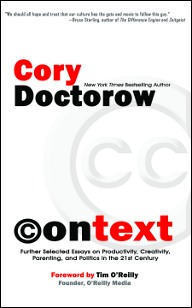
Monday Book Review: Context by Cory Doctorow

I decided I was going to read a book a week for a year, here's a quick review of this weeks book.  You can see the ongoing list here.


Basic Info


Context: Further Selected Essays on Productivity, Creativity, Parenting, and Politics in the 21st Century by Cory Doctorow 


Note: you can download the book for free here


Why I bought it

I was literally in the Ottawa airport en route to Chicago for the weekend and needed some reading material for the plane.  I stopped in the book store, had a look through the titles and was about to walk away empty handed when I spotted this on another shelf by the cash register.

I first saw Doctorow on TVO's The Agenda with Steve Paikin a couple of years back and have been loosely paying attention to his work since.


How it connects to the public sector

The essays in the book deal largely with technology, security, and copyright providing context (hence the title) around these issues in a practical and accessible way.  Case in point on IT security:

"Users will always prioritise getting their job done over honouring your network policy, and who can blame them?  If networks policy breaches aren't followed up with safe solutions to user' demonstrated needs, they'll keep on happening, no matter how much security you put between your users and their duties." -- Cory Doctorow, Like Teenagers, Computers are Built to Hook Up


What I got out of reading it

Context was a really easy read. Since it's just a collection of essays (on a host of related issues) it's hard to nail down a single take away.  That said, over the course of the book Doctorow repeatedly shows how out of touch incumbent businesses are, how the regulatory responses they are lobbying for (to protect their incumbency) are flawed, and how much better off we would be if we simply thought through these issues with a bit more of a critical lens.  

Much of the book has to do with copyright, so if you aren't interested in the subject matter you may want to skip this one.  However, I'd encourage you to watch to the interview below before you make your decision.  If nothing else, Doctorow is thoughtful and articulate, which makes him incredibly easy to listen to.


Originally published by Nick Charney at cpsrenewal.ca
subscribe/connect
RSS / cpsrenewalFacebook / cpsrenewalLinkedIn / Nick Charneytwitter / nickcharneygovloop / nickcharneyGoogle+ / nickcharney

Friday, 2 March 2012

On Engagement, Honesty and Walking Away in Austere Times

These are tough times and as many instinctively brace for impact in the face of looming cuts, I wanted to take a step back and reflect a little.


If you don't find your work engaging, perhaps now is the best time to walk away

If the reason you work in the public sector is the stability, I would argue that that reason no longer exists. If you need evidence look at the magnitude of the projected cuts.

In austere times, we probably need engaged public more than ever.


Untitled by Fire At Will [Photography]
Walking away from a job takes courage and honesty

It's a kind of courage that isn't easy in bleak economic times, but one that will be offset by a kind of honesty that's both personally satisfying and deeply moving to others.

I know we all have to put food on the table and clothes on our backs, but if it came down to you or someone else you know - say a friend - who was far more engaged in their work than you were, wouldn't you want to see them continue that work?

If the roles were reversed, wouldn't you want someone to step in and offer you the same opportunity?

I know I would.


One last thing

The worst thing anyone could do right now is make uniformed decisions.  There are a number of options available to public servants affected by Work Force Adjustment (WFA) (including alternation which I refer to implicitly above); I had no clue what these were until a friend sat me down and walked me through them.

I strongly recommend speaking to your manager, your human resources officer, your union rep, or consulting the Treasury Board website for more information; the budget drops March 29th.


Originally published by Nick Charney at cpsrenewal.ca
subscribe/connect
RSS / cpsrenewalFacebook / cpsrenewalLinkedIn / Nick Charneytwitter / nickcharneygovloop / nickcharneyGoogle+ / nickcharney

Monday, 27 February 2012

Monday Book Review: Trickster Makes This World by Lewis Hyde

Basic Info

Trickster Makes This World by Lewis Hyde

Why I bought it
"from the ink of the text ... " by ๓ậтëø 

After watching Emily Levine's TED talk I knew I had to read this book; my only regret is having waited so long to actually do so.

How it connects to the public sector

While the book itself is technically an exercise in comparative anthropology, Hyde's ability to explain the disruptive side of the human imagination in great detail makes the book incredibly relevant for anyone looking to re-imagine the status quo.

After having read Trickster, I wrote a pair of posts that explicitly connected disruptive innovation with Hyde's anthropological arguments; in fact, Innovation is tricky, literally ... and Finding Innovation are two of my most heavily trafficked posts from last year (despite a noticeable lack of comments).

What you will get out of reading it

I honestly can't explain just how important this book has been to me personally and professionally. I read it at a time when I was in a bit of trouble at work (long story) and being able to contextualize my experience within the narrative of the book gave me some much needed perspective.

If you are interested disruptive innovation, this book will not only shape your understanding of the discipline, but will also outline what you can expect if you are successful, and just as importantly, what you can expect if you aren't.


Originally published by Nick Charney at cpsrenewal.ca
subscribe/connect
RSS / cpsrenewalFacebook / cpsrenewalLinkedIn / Nick Charneytwitter / nickcharneygovloop / nickcharneyGoogle+ / nickcharney

Friday, 24 February 2012

Think, write, repeat

While you may be able to download an application that turns even your crappy cell phone pics into something hipsters will rave about on Facebook, or transform your worst karaoke showing into a pop song that would make Bieber proud, there isn't an app on earth that can make you a better critical thinker, or compensate for deficient writing skills.  In a world where (almost) everyone is a publisher, good writing skills and the ability to think critically are likely key differentiators.  


They are also mutually reinforcing

The more you think critically the better you are at expressing those thoughts in writing, the more you express those thoughts in writing, the deeper you can push your understanding.  

The thoughts I share here are ones I bat around in my head for weeks at a time.  What goes live on Friday mornings is always something that has been written, rewritten, completely torn apart, and slowly pieced back together.  I understand that the process, while often brutal and stressful, ultimately leads to a depth of understanding that I couldn't achieve if I simply shot from the hip and riffed on a particular subject.  In fact, over the years, I have collected a number of unfinished blog posts (over a hundred in fact) that I simply haven't been able to frame properly yet.

But this blog is not just a training ground for my skills, it is a living and growing portfolio that demonstrates those skills in action, and as such it's become far more valuable than my (traditional) resume alone (more on this below). 


It's a knowledge economy, stupid

The problem with a conventional resume is that it actually doesn't demonstrate any of the abilities listed on it (with the possible exception of effective communication). This week I came across a post called "Github is my resume" (via Ycombinator).  In it, a Python coder (named pyDanny), argues that, while traditional resumes are a passive inventory of tasks and responsibilities (and thus ripe for embellishment), an online repository of your work (in his case Github) is an active demonstration of those abilities. The comments on the article brought some nuance to the discussion, which eventually settled on the idea that a static resume is still a valuable tool, but what programmers really need (and what a service like Github can be) is a portfolio.

Given, I'm not a coder (you might not be one either) but the logic is the same (paraphrasing pyDanny): 


If you write every day or every week, over time your writing will get better; you'll also be able to demonstrate a consistent body of work, and your passion will be obvious. 

Where's your passion?

Where is your living portfolio? 

Isn't it time you started thinking, writing and repeating?


Originally published by Nick Charney at cpsrenewal.ca
subscribe/connect
RSS / cpsrenewalFacebook / cpsrenewalLinkedIn / Nick Charneytwitter / nickcharneygovloop / nickcharneyGoogle+ / nickcharney

Monday, 20 February 2012

Monday Book Review: Program or Be Programmed by Douglas Rushkoff

Basic Info 

Program or Be Programmed: Ten Commands for a Digital Age by Douglas Rushkoff


Why I bought it

I read an article Rushkoff published (on CNN) entitled Are Jobs Obsolete and immediately thought anyone who is willing to ask a question that challenges the very assumptions underlying our problems is worth investigating. Here the excerpt that got my attention:
I am afraid to even ask this, but since when is unemployment really a problem? I understand we all want paychecks -- or at least money. We want food, shelter, clothing, and all the things that money buys us. But do we all really want jobs?

How it connects to the public sector

A number of Rushkoff's arguments resonate with my experience in the public sector; and while I won't get into each one, Rushkoff's second chapter hit particularly close to home. In Live in Person, he argues that:
Digital networks are decentralized technologies. They work from far away, exchanging intimacy for distance. This makes them terrifically suitable for long-distance communication and activities, but rather awful for engaging with what - or who - is right in front of us. By using dislocating technology for local connection, we lose our sense of place, as well as our home field advantage.
I can't even count how many times have I've been sitting in "important" meetings only to find my colleagues praying to their blackberry and otherwise ignoring what is directly in front of them: me, others, the issue at hand, and even the solution to the day's problem.

That said, I have to admit that I've been both a perpetrator and victim, I've both ignored and been ignored.  It's become a part of the culture, but according to Rushkoff, it doesn't have to be.


What you will get out of reading it 

At its core the book is about the need to think critically about what is happening around you and making willful choices about the roles we all play; and while the book uses the specific example of programming, the same philosophy (as I have written previously) applies to the public sector.

 If you are looking for a wake up call in the digital era, this may be it.


Originally published by Nick Charney at cpsrenewal.ca
subscribe/connect
RSS / cpsrenewalFacebook / cpsrenewalLinkedIn / Nick Charneytwitter / nickcharneygovloop / nickcharneyGoogle+ / nickcharney