Tuesday, 29 September 2015

The Ship's Doctor, Or, the Difference Between Skill and Expertise

by Kent AitkenRSS / cpsrenewalFacebook / cpsrenewalLinkedIn / Kent Aitkentwitter / kentdaitkengovloop / KentAitken

This is a quick reflection on HR and the difference between skill and expertise, but let's start with Firefly.

The show Firefly followed a crew of spaceship smugglers, each with a distinct role on the ship: Malcolm, the Captain; Zoe, the first mate; Hoban, the pilot; Inara, the "diplomat;" Jayne, the mercenary; Kaylee, the mechanic; and Simon, the ship's doctor.

The thing is, they only have so much room on board, and they only make so much money. And every additional crew member reduces the percentage of profits for the others - it's expensive to keep people on.

Therein lies the problem with the setup. Everyone pulls their weight, but it's a pretty crude division of skills: the only options for medical care, for instance, are to have no doctor or a full-time doctor as part of the crew and cut of earnings. In the middle of space, there's no scaling to needs. Everyone else could learn some field dressing and first aid, but it's a far cry from a trained, professional surgeon when you really need one.

The analogous situation for an organization's HR is the question of whether you find specialists or train generalists in new skills. The example that came up recently was about facilitation, and a colleague and I discussed the difference between a moderator - someone who can keep a conversation moving productively - and a trained facilitator, who can design a productive session and get the absolute most out of the brainpower in a room. But there are many such fields: data analytics, engagement, usability, research techniques, and on (or anything that fits the model described in the post Innovation and Rigour).

The problem is that very few teams, staffed permanently with a particular crew with a particular set of skills, need a full-time facilitator. But they also don't need everyone trained lightly in facilitation - it's like the difference between first aid and surgery. What these teams need is reliable, scaleable access to a surgeon when someone gets badly injured. Or, less darkly: reliable, scaleable access to specialized, expert skills on demand. For example, one would only bring in a facilitator when they host major meetings or workshops, or during strategic planning exercises.

The alternatives are dicey. To a point, a culture of collaboration solves the dilemma. But that requires that enough teams have these mutually dependent features:
  1. They've identified a need for specialized expertise
  2. They're willing to fill a valuable, rare open position with that particular expertise
  3. They have enough flexibility to lend that person, on demand, to other teams
Which is unrealistic at worst, and unreliable at best.

Otherwise, there are several models proposed to solve this dilemma: Govcloud or STRATUS, both of which require a bank of expert employees who are not permanently bound to any particular program or set of deliverables. It's comparable to the "corporate services" approach (HR, finance, IT, procurement) but for non-standardized work, where expertise meets policy and program knowledge.

Regardless, the status quo has a gap that most organizations currently cannot appropriately address. But it's the world we inhabit: incredibly high standards for program and service delivery, with increasingly niche approaches to getting there, that may not fall neatly into 40-hour-per-week job descriptions. Have people squared this circle? Are there any other approaches that are working well?

Friday, 25 September 2015

On the Rise of Policy Instrument Constituencies

by Nick CharneyRSS / cpsrenewalFacebook / cpsrenewalLinkedIn / Nick Charneytwitter / nickcharneygovloop / nickcharneyGoogle+ / nickcharney

I read an interesting paper on policy innovation a couple of weeks ago entitled: Instrument constituencies and the supply side of policy innovation: the social life of emissions trading. I wanted to share it specifically in the context of my recent exploration of the #w2p online community (See: The Gentrification of #w2p) because I think it has some explanatory (and predictive) power.

Here's the somewhat academic abstract:
We offer a perspective on the making of policy instruments over time. This sheds light on the work that goes into articulating and maintaining instruments as both models and implemented policies, and the social formations that arise therefrom. Drawing on a brief case study of the innovation of emissions trading, we show the role of both functional promises to deliver public-policy outcomes and structural promises concerning new positions for the actors involved. We show how the making of instruments can coincide with the formation of ‘instrument constituencies’, which consist of entangled practices that cultivate an instrument. Constituencies sustain the instrument and are themselves sustained by the instrument as it persists and expands its realm of validity. We conclude that policy instruments can develop social lives of their own with dynamics that should be taken into account by scholars of innovation in governance.

Plain English tl;dr:
A policy constituency forms alongside the emergence of a new policy instrument. This group of actors has an inherent interest in the successful development and mainstreaming a new policy instrument because that mainstreaming creates an environment where those with instrument expertise (the constituency) are in higher demand and given positions of authority and influence; this is one of the defining characteristics of supply side innovation.

First, this isn't a judgement call on anyone

I think it's important to note that the research is value neutral in terms of whether or not instrument constituencies are inherently good or bad things, they simply are. If anything the authors want to put the constituency issue on the radar because quite often it is overlooked.


Second, this is gentrification by another name

This squares nicely with my earlier analysis of the gentrification of #w2p (again, see: The Gentrification of #w2p); where obviously the policy instrument in question was social media.


Third, this offers us some predictive capability

Namely, that this is likely to happen (or is already happening) in other hot emerging policy areas/instruments right now:

  • Open Data
  • Policy Innovation
  • Design Thinking
  • Behaviorial Economics
  • Social Finance

Fourth, you may want to know how to spot members of the constituency

If you are looking to suss out whom might fall into a particular constituency it may be worth thinking about whether or not a given person more readily identifies with the policy instrument with which they work or the policy domain within which they work. In other words, is he an "open data" guy, or is he a "Treasury Board" Guy?


Fifth, its important to know who's who

Knowing who the members of the constituency are is important because the evidence indicates that these will be the people with greater influence down the road, they are likely people you want to cultivate relationships with now, before everyone else starts coming out of the woodwork.


The only trick is picking the right instruments. 

Not all innovation takes root. Not all new instruments mainstream. There was an early push on crowd-souring years ago. A lot of people took kicks at that particular can, its a tool that is still in use, but not nearly as widely as was originally thought.

Friday, 11 September 2015

On the (Seemingly) Partisan Nature of Public Sector Unions

by Nick CharneyRSS / cpsrenewalFacebook / cpsrenewalLinkedIn / Nick Charneytwitter / nickcharneygovloop / nickcharneyGoogle+ / nickcharney

Can someone please reconcile something for me?

How can public service unions engage in (seemingly) partisan activities such as "jump[ing] into the third-party advertising fray for the current federal election campaign" while still purporting to represent the interests of the professional and non-partisan civil servants who make up their membership?

Consider the following the Professional Institute of the Public Service of Canada's recent press release entitled "Radio ads poke fun at Harper government to raise awareness of the impact of government science cuts and muzzling" (click to enlarge):


Or, if you prefer, listen to the ads themselves. Their permissibility seems to stand in stark contrast to the non-permissibility of similar actions by individual civil servants (See: On Non-Partisanship and Anonymity in the Internet Era).

Am I missing something?


Wednesday, 9 September 2015

The Next Big Thing

by Kent AitkenRSS / cpsrenewalFacebook / cpsrenewalLinkedIn / Kent Aitkentwitter / kentdaitkengovloop / KentAitken

Almost a year ago, Tariq, Nick, and I caught up for drinks and to bounce around ideas for CPSRenewal. We felt that the vibe of the blog had been changing. Nick had originally envisioned it as “Lifehacker for government,” which led to posts that made sense of trends and provided advice on how to make the most of new platforms and tools*. And we agreed that as time went on there were fewer of those future-focused posts.

For a while I worried about that change, as if I was missing something. But now my theory is this: I don't think sensemaking the future is as unique and valuable as it once was, for a few reasons:


1. People can choose to ignore ignorable things
2. The future is becoming less predictable
3. Being hyper-networked isn’t special


Ignorable things


Organizations will change for at least two reasons: when there is a burning platform (an urgent need or pressure for change), or when the benefits of change are obvious (and the opportunity cost of not changing is great and obvious). However, public organizations have a high threshold for what constitutes a burning platform. Ten years into Twitter's existence, governments worldwide are using still social media as a broadcast-only channel. There's really no possibility for catastrophe resulting from a cautious approach here.


Calculating the benefits of change is tricky here too. Any change, no matter how obvious a win it would be in a vacuum, requires one of an organization's scarcest resources: management attention. It doesn’t work if a requirement to realize an activity's benefits (or avoid costs) is the attention and approval of an executive who can provide neither. There is a vast and powerful attention economy within public institutions.


The future is becoming less predictable


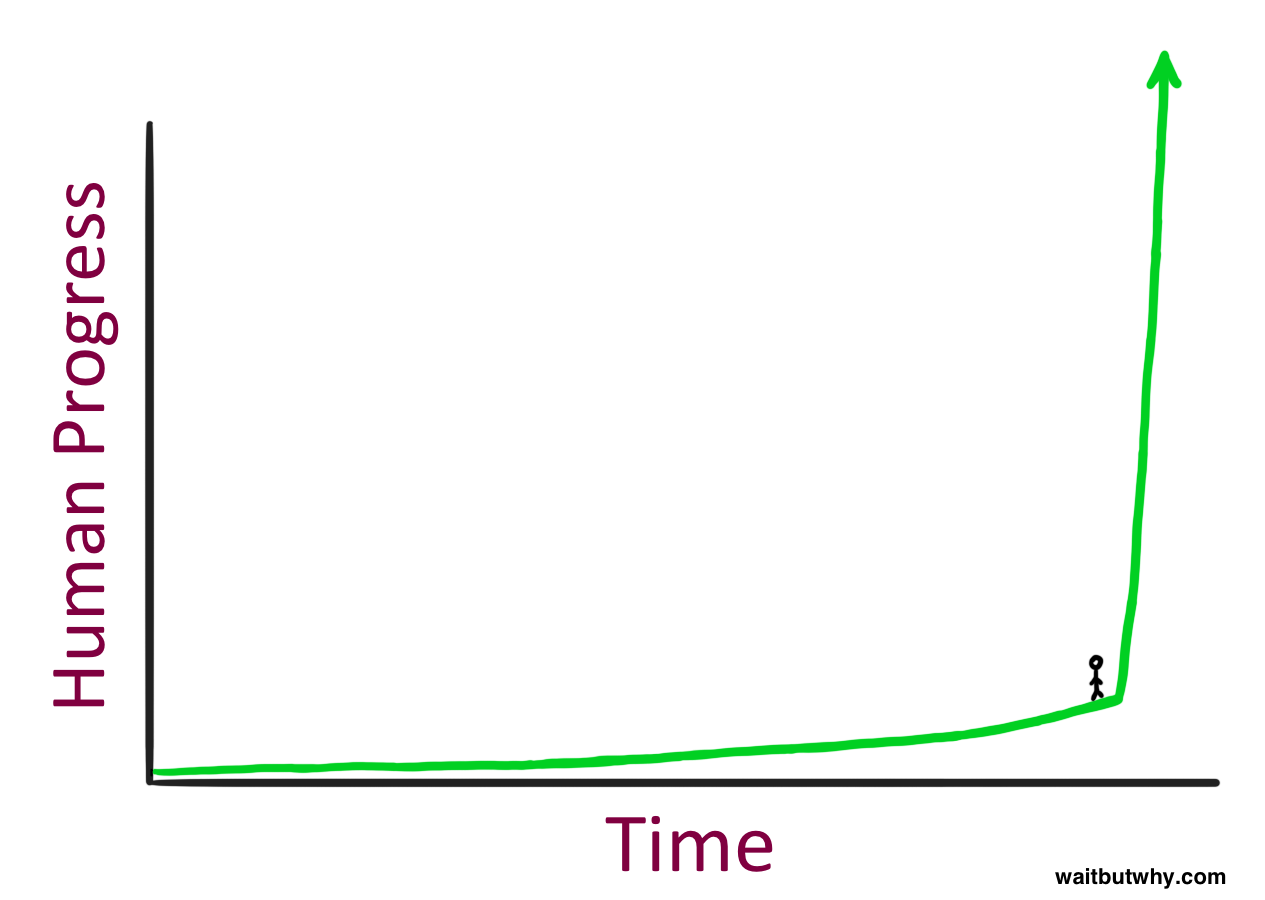
I highly recommend that you read Wait But Why's piece on artificial intelligence. In particular, the opening section on why we can’t picture the magnitude of changes coming in the future. It opens with a graph, and the question "What does it feel like to stand here?"


Edge1


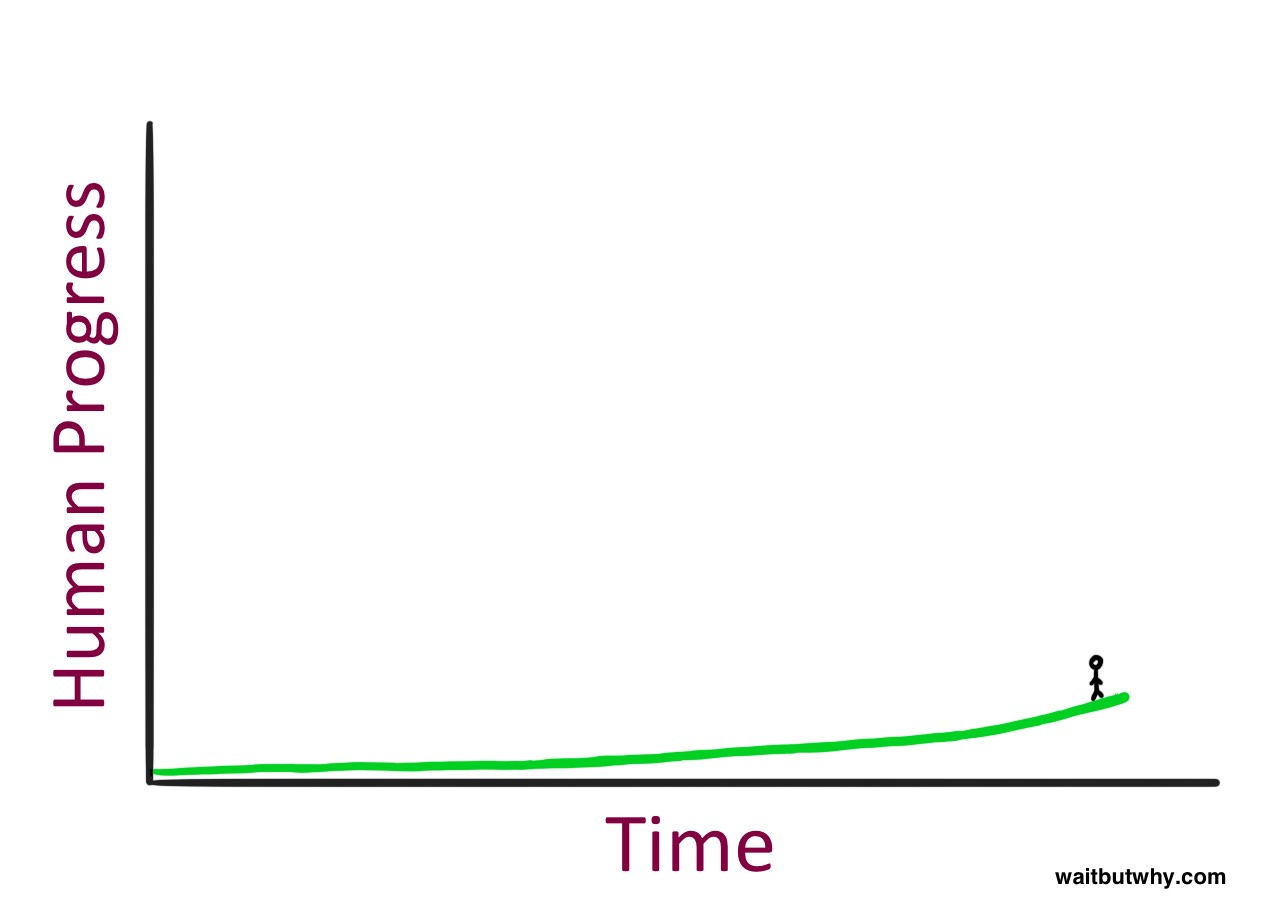
"It seems like a pretty intense place to be standing—but then you have to remember something about what it’s like to stand on a time graph: you can’t see what’s to your right. So here’s how it actually feels to stand there:"


Edge


We have a growing body of evidence suggesting that change is occurring on an exponential scale, in several ways. And we can understand that idea rationally; we've pretty well internalized it.


"We have all heard this before, but constant change is the norm and the speed of change is staggering...

The complexity of the issues we face is also growing across all domains—fiscal, health, environment, security, diplomacy, development, defence, transportation, to name a few. "
- Janice Charette, Clerk of the Privy Council [source]


But, like the figure in that second graph, we tend to revert back to thinking that we can manage that level of change. The problem is that our brains are swapping one question for another without us knowing it. Instead of answering "Will the near future look very different from the present if we’re experiencing an exponential rate of change?" we're answering "Can I personally imagine the effects of exponential change on the near future?" and the answer is actually that no, we can’t. We tend to just mentally extend the trendline from the last few years.


How we deal with a largely unpredictable future merits much longer shrift. For another time.


Hyper-networked isn't special


In the earlier days of the digital (and particularly social) world, finding insights in other fields or sectors of the economy and being able to imagine them applying to government was a really useful skill.


The thing is, it no longer takes research or even much insight to recognize useful tools or credible change drivers. We can replace "Aha!" moments with mental shortcuts, and the way we find information provides cues about people's intelligence and authority. For instance, if X colleague and Y scientist reference Z person's idea, and we think X and Y are smart, we'll probably think Z is smart and the idea holds water. An extreme example would be when Stephen Hawking, Elon Musk, and Bill Gates warn about artificial intelligence. They're smart, and when other smart people agree with them, the idea is credible. It doesn't take any understanding of AI on our part to catch a glaring hint about its importance - all we've done is compare the claim against a mental rolodex of trusted sources. Search algorithms, human curation, and the existence of instructions for pretty much anything have hugely leveled this playing field.

It was easy to see Uber coming, but much harder to prepare for it. Which is why taxi drivers were still protesting in Ottawa yesterday.


The next big thing


So I’m left thinking that the Next Big Thing is that we get better at how we make sense of purported Next Big Things, and we get better at how we handle constant Big Things that we won’t really see coming. Which would mean we need to dig into and dissect the concepts of foresight, change management, adaptability, agility, resilience (agility and resilience being two very different things), and take them far, far more seriously.


*A quick note on future-focused posts: long before I joined the site, posts like this hugely impressed me: Signal to Noise. I still find those kinds of posts to be strong, and they seem to garner more interest:


Friday, 4 September 2015

On Non-Partisanship and Anonymity in the Internet Era


by Nick CharneyRSS / cpsrenewalFacebook / cpsrenewalLinkedIn / Nick Charneytwitter / nickcharneygovloop / nickcharneyGoogle+ / nickcharney

By now you ­ – if you are a federal public servant – you are likely familiar with the (infamous?) ‘Harperman’ YouTube video.  If you aren't, feel free to read any of the following (and I'm sure I missed some):

Ottawa Citizen
National Post
Macleans
Globe and Mail
CBC
The issue was top of mind for a few days (in Ottawa at least); the view counter on the video went from about 40k to over 500k views on the back of mainstream media attention and sharing via social media, a website was stood up, and a crowdfunding campaign launched.

Now, I don't plan on wading into dangerous waters on this one but I did want to table a couple of issues that I think are worth thinking about:
  • This isn't actually all that newsworthy, especially to those outside the Ottawa bubble; blame journalism's broken business model that rewards emotive, sensationalistic reporting and our propensity for scandal.
  • The attention brought on by the investigation made this more of a story than it should have been; blame the Streisand effect.
  • None of this would be possible without the Internet; blame Vint Cerf.

Basically - the web is acting as a solvent to some of Westminster's oldest conventions (in this case non-partisanship and anonymity). All that said, Daniel Blouin posted a series of Tweets about the issue from his own perspective, I've assembled them in a storify that I've embedded below. It's worth reading.