Showing posts with label blueprint 2020. Show all posts

Wednesday, 22 June 2016

A quick stock-take on public service renewal

by Kent AitkenRSS / cpsrenewalFacebook / cpsrenewalLinkedIn / Kent Aitkentwitter / kentdaitkengovloop / KentAitken

Last week I almost wrote a post just to announce a hiatus for the summer. I’m getting into the home stretch of an MSc dissertation. A break would be a little about freeing up time, but at least as much about A) simplification of my weekly to-do list and B) trying to keep some semblance of a quality standard in my writing. I think I’ll stop short of a full hiatus, and just apologize for sparse posts for the next few months. Which probably feels to me like a much bigger deal than it is, but I like the weekly rhythm.

I’d like to keep it up because I do feel like writing these days. There’s a ton going on around the public service that is inspiring me lately and bouncing around my head. In 2012 I wrote about possibilities for tectonic change in the public service, and I’m starting to feel like some of those ideas are becoming real. Not for any one reason - it’s many things lining up and coming together.

When looking for something like “culture change,” it’s sometimes hard to differentiate between what’s actually different and what you, yourself, are seeing differently. It’s inevitable that the longer you've been around, the more you’ll see of everything: the good, the bad, and the ugly.

And with that massive bias in mind, I’m still more optimistic about the future - this whole 
“public service renewal” thing we keep banging on about - than I have been for a long while. I’m thinking of things like digital service redesign (maybe with some friendly competition from Ontario’s soon-to-be-minted Chief Digital Officer), citizen engagement on policy making, and more opportunities to work with the private sector and civil society - including more opportunities for civil society to hold government accountable to outcomes.

Part of the interest here is the potential to get out of our comfort zones a little bit and experiment with different ways of doing government. But there’s a value proposition much deeper than “experiment and we’ll see if it works” here. One of the threads that connects digital service, citizen engagement, and government releasing more information is that whole accountability piece: people and organizations having more information, and more avenues, to put pressure on government. Which will have its bad sides as well, but if nothing else will nudge government towards more honesty and authenticity.

I’ve felt the conversations - and communications products - changing over the last few years. It’s harder to respond with talking points to people who can talk back.

And, it’s harder to respond with talking points to people who you really understand and empathize with, which is one of other connecting threads. I’ve made this point before, but here it is a tad more bluntly: whether or not a given public servant truly understands their stakeholder communities may be the single biggest factor influencing their perspective on their work.

Jared Spool’s research on usability and design keeps coming back to this magic number: 2 hours every 6 weeks interacting with the end users of a thing. For everyone who influences the design (that includes senior executives) I’d argue that this principle would apply to a surprising range of things: products and websites, but also policies, service interactions, and communications.

The good news is that we’re all increasingly becoming front-line public servants.

Which means that not only are things poised to get better, but poised to get systematically better, which is the real kicker.


Friday, 22 April 2016

The Most Important Takeaway from the #gc2020 Innovation Fair


by Nick CharneyRSS / cpsrenewalFacebook / cpsrenewalLinkedIn / Nick Charneytwitter / nickcharneygovloop / nickcharneyGoogle+ / nickcharney

I managed to pop into the second annual Blueprint 2020 Innovation Fair earlier this week for about 90 minutes. The space was jammed, there were people everywhere, and energy was high. If you are interested in a summary. there's one over at The Public Servant. If you are interested in my key takeaway, read on, it's brief -- and to be perfectly honest, not even my insight.


I was joking around with a longtime friend, colleague and trusted source of advice who replied to a half-joke I made about the fact that "there's a whole bunch of people here doing a whole bunch of things I've never heard about" -- which as an aside, if you step back is also likely one of the reasons to have the fair in the first place, broader socialization and connection between actors -- with: "Isn't that precisely what we want? To get past the point where any single actor can keep track of the players and innovations moving around the system."

Fair point.

Great insight.

If tipping points exist, and if scale is an early indicator of whats to come, then surely the success of the fair is an indication that we are moving further and further down the innovation / adoption curves. Now, obviously, that doesn't mean the work is done -- in fact it may mean that for many the work is about to begin -- but it also may mean that there's more receptivity to it then there has been previously.

Kudos to the Blueprint team for a job well done.


Wednesday, 14 October 2015

Innovation is Information

by Kent AitkenRSS / cpsrenewalFacebook / cpsrenewalLinkedIn / Kent Aitkentwitter / kentdaitkengovloop / KentAitken

In August, the Clerk of the Privy Council delivered a speech titled “A National Dialogue On Policy Innovation.” Elsewhere, #policyinnovation is one of the most used hashtags by Canadian public servants. It’s somewhat of a hot topic right now. But what is "policy innovation" in the first place? 

For starters, it could refer to "new and interesting ways of developing policy." Or, "new and interesting policy." (See: On Prioritizing Policy Innovation) We tend to use both versions almost interchangeably, but this post tilts towards the former usage. I’ve heard the term used to refer to crowdsourcing and challenge prizes, deep dives into technological and social trends, improvements to government services, behavioural economics, and much more.

But within that nebulous concept, I think there's a central core to the entire idea that may be a useful way to think about how we gather and understand evidence, and how we make and implement decisions. It's all about information.

More options means more precise application


To back up slightly, let’s consider another arc of innovation that is both an analogy and a predecessor, that of telecommunications. We’ve gone from letter-writing to printing presses, telegraphs, telephones, the internet, and now to low-cost ubiquitous mobile connections. Every combination of one-to-one, one-to-a-select-few, one-to-many, public forums, with every combination of attributed or anonymous, for every combination of formats, all at a vanishingly small cost.

But here's the key: at one point, to communicate long-distance you had one option: handwriting a letter. Later, you had two: handwriting a letter, or paying to have something reproduced many times on a printing press. You didn't have to rely on a letter when it wasn't the best option. As more and more options became available, you could match your communications goal more precisely to different ways to achieve it.

Likewise, now we have a wider range of policy development approaches and policy instruments, which means there’s a greater chance that we can match the right approach to the right situation. We have a wider range of options partially because we get inventive over time, but far more so because policy development and implementation often is communication and so we’re simply piggybacking on telecommunications advances.

The information


Which isn’t much of an insight, I recognize. Yes, the internet opens up options for how government does things. But if we start to think of policy innovation as communication, instead of as enabled by communication, it starts to shed light on what we’re really trying to accomplish, and where “innovative” approaches fit in more “traditional” approaches. Using the terms in quotations lightly.

Basically, the approaches that get pegged as "policy innovation" often boil down to two key actions:

  • transferring information between people
  • arranging information for people

It’s the crux of crowdsourcing, policy or service jams, innovation labs, open data, design thinking, challenge prizes, and citizen engagement approaches like consultations, townhalls, and social media chats. Someone has information that policymakers can use: ideas, problems, slogans, lived experience, or academic expertise (see: The Policy Innovator's Dilemma). Then it’s a matter of finding the best way to access it, which is a question of format. You just have to learn the formats. Similarly, once you've crossed the threshold and learned a new telecommunications approach (case in point might be parents and grandparents on Facebook), it becomes part of a passive mental algorithm that takes a need or goal and instantly knows how best to accomplish it.

Talk of policy innovation tends to go hand-in-hand with the idea that policy issues increasingly cross jurisdictional or societal boundaries, and are a part of an increasingly complex environment (see: Complexity is a Measurement Problem or On Wicked Problems). Which is where arranging information becomes invaluable.

Let's say  you get ten informed stakeholders of a given policy question in a room, and ask each for their concerns. They each reveal a different way of looking at the issue, revealings its complexity and pointing out legitimate pitfalls for policy options. The problem is that by the time the tenth stakeholder spoke you forgot the concerns of the first five, so it's impossible to understand all ten in context. It's Miller's Law: human beings can only hold seven things, plus or minus two, in our working memory. Which is where techniques like journey mapping, system mapping, and sticky noting everything are crucial for policy. They're the policy landscape equivalent of doing long division on paper so you can remember everything in play - what we might call mental scaffolding

Many approaches include both transferring and arranging information. For instance, a public consultation might include a call for ideas with a voting mechanism that creates a ranking, signaling importance. Some deliberation platforms include argument mapping systems that use algorithms to arrange the discussions for participants, almost like Amazon bringing complementary products to the forefront. ("Are you outraged at your government about X? Many people outraged about X are also outraged about Y, perhaps you should consider lambasting them on that topic too.")

In other cases, governments can (and should) map out what they already know about a given policy issue to get it out of working memory and focus on change drivers and relationships between forces. This will become increasingly important if we truly want to get out of siloed policy-making, find hard-to-see connections between once-distinct policy areas, and genuinely understand entire systems. Our governance model was built for a world we falsely believed was simpler than it was, and within that we're running into our own cognitive limits. We literally cannot hold all the elements of a complex policy issue in our heads without some kind of mental scaffolding, be it tools, other people, or paper.

Metadata

Two notes on metadata, or information about information (an example would be how DSLR cameras automatically include date stamps, aperture, shutter speed, iso, and more information in image files).

First, some approaches that get lumped in with policy innovation don't fit perfectly with the transferring and arranging information categories. Behavioural economics, for instance (and its service delivery cousin of user testing), seems more like creating new information through research. But viewed from a policy lens, I'd suggest it's actually more like metadata.

Let's say government wants to maximize the rate of tax returns, so tweaks the language on letters to taxpayers to see what framing resonates with people. Here's the UK example:

"...replacing the sentence “Nine out of 10 people in the UK pay their tax on time” with “The great majority of people in [the taxpayer’s local area] pay their tax on time” increased the proportion of people who paid their income tax before the deadline."

The core policy instrument here is a law, and the letter sent to taxpayers is supporting education about the importance of filing tax returns. In this case, the information is in the letter. The behavioural economics piece is metadata about that information: how many, and which, people acted upon the information they received. It's still really about transferring information between people, which puts tools like behavioural economics and data analytics in this common framework and may help practitioners navigate between possible approaches.

Second, there's a meta-level to the idea of transferring and arranging information that changes the value of different approaches and formats. We might call it "conspicuous innovation" or "conspicuous engagement." Basically, the transfer and arrangement of information is not the only goal achieved by these approaches - someone emailing a policymaker a vital piece of information for a policy question is worth less than that same person posting it publicly during an official consultation. The metadata for that piece of publicly posted information includes the number of views from other people, the signals about government's attitude towards governance and transparency, and the future value to others. 

So what?

The "policy innovation" toolkit centers around two actions: transferring information between people and arranging information for people. Past this common core, it's often a question of forums and formats (increasingly, but not uniquely, about how we transfer information from non-governmental actors) (with exceptions, of course). So what?

One, I think it's worthwhile to examine what binds the idea of policy innovation together, to refine our working concept of the term.

Two, I think thinking in these terms highlights what we're actually trying to accomplish through these approaches, and might make it easier to choose between them.

Three, putting them in a historical context puts the perceived risk in context. I mean two things here: first, that policy innovation is very similar to our personal experience with telecommunications advances: more options allows more niche approaches, and eventually they become routine. Second, that if some of these approaches are at a fundamental level analogous to things government has been doing for ages, they seem less daunting. For instance, there are dozens of consultations ongoing at http://www1.canada.ca/consultingcanadians at any given time. It's just a different way of transferring information between people and policymakers.


Thank you to Blaise Hebert and Nick Charney for super interesting conversations on this topic.

Also, two recent posts from Melissa that are good general fodder here: What Innovation Feels Like, Part 1: Fear; and Part 2: Lack of Trust

Wednesday, 9 September 2015

The Next Big Thing

by Kent AitkenRSS / cpsrenewalFacebook / cpsrenewalLinkedIn / Kent Aitkentwitter / kentdaitkengovloop / KentAitken

Almost a year ago, Tariq, Nick, and I caught up for drinks and to bounce around ideas for CPSRenewal. We felt that the vibe of the blog had been changing. Nick had originally envisioned it as “Lifehacker for government,” which led to posts that made sense of trends and provided advice on how to make the most of new platforms and tools*. And we agreed that as time went on there were fewer of those future-focused posts.

For a while I worried about that change, as if I was missing something. But now my theory is this: I don't think sensemaking the future is as unique and valuable as it once was, for a few reasons:


1. People can choose to ignore ignorable things
2. The future is becoming less predictable
3. Being hyper-networked isn’t special


Ignorable things


Organizations will change for at least two reasons: when there is a burning platform (an urgent need or pressure for change), or when the benefits of change are obvious (and the opportunity cost of not changing is great and obvious). However, public organizations have a high threshold for what constitutes a burning platform. Ten years into Twitter's existence, governments worldwide are using still social media as a broadcast-only channel. There's really no possibility for catastrophe resulting from a cautious approach here.


Calculating the benefits of change is tricky here too. Any change, no matter how obvious a win it would be in a vacuum, requires one of an organization's scarcest resources: management attention. It doesn’t work if a requirement to realize an activity's benefits (or avoid costs) is the attention and approval of an executive who can provide neither. There is a vast and powerful attention economy within public institutions.


The future is becoming less predictable


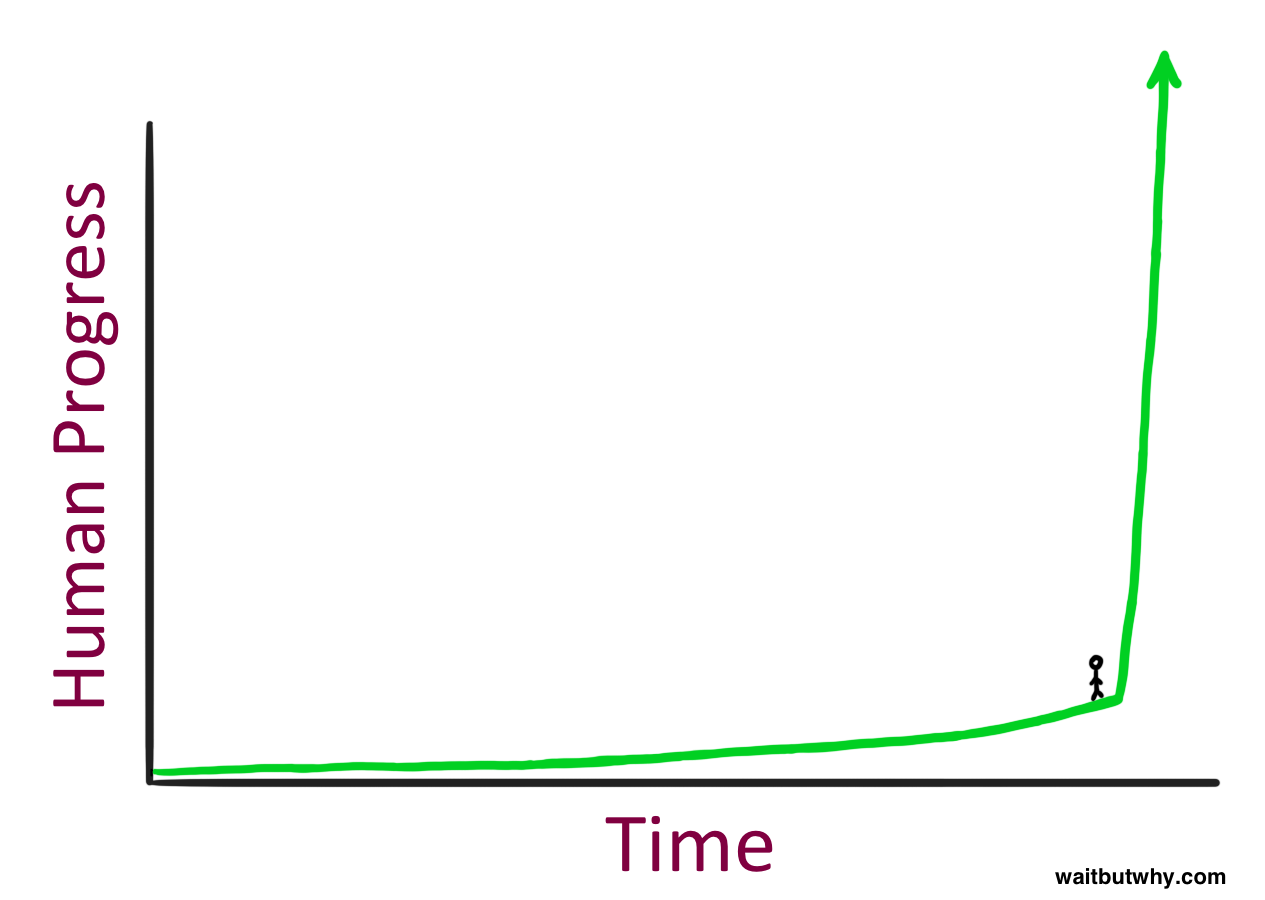
I highly recommend that you read Wait But Why's piece on artificial intelligence. In particular, the opening section on why we can’t picture the magnitude of changes coming in the future. It opens with a graph, and the question "What does it feel like to stand here?"


Edge1


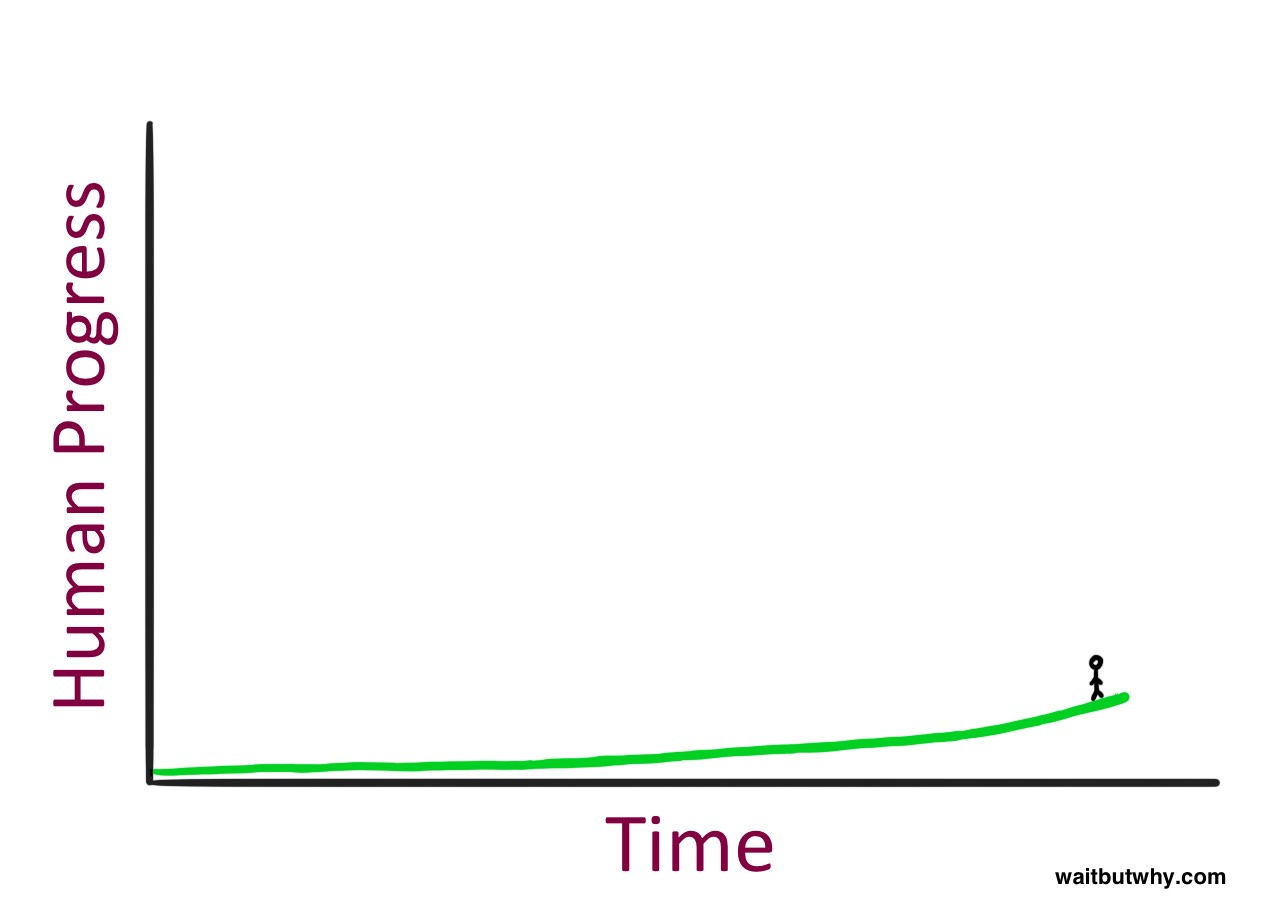
"It seems like a pretty intense place to be standing—but then you have to remember something about what it’s like to stand on a time graph: you can’t see what’s to your right. So here’s how it actually feels to stand there:"


Edge


We have a growing body of evidence suggesting that change is occurring on an exponential scale, in several ways. And we can understand that idea rationally; we've pretty well internalized it.


"We have all heard this before, but constant change is the norm and the speed of change is staggering...

The complexity of the issues we face is also growing across all domains—fiscal, health, environment, security, diplomacy, development, defence, transportation, to name a few. "
- Janice Charette, Clerk of the Privy Council [source]


But, like the figure in that second graph, we tend to revert back to thinking that we can manage that level of change. The problem is that our brains are swapping one question for another without us knowing it. Instead of answering "Will the near future look very different from the present if we’re experiencing an exponential rate of change?" we're answering "Can I personally imagine the effects of exponential change on the near future?" and the answer is actually that no, we can’t. We tend to just mentally extend the trendline from the last few years.


How we deal with a largely unpredictable future merits much longer shrift. For another time.


Hyper-networked isn't special


In the earlier days of the digital (and particularly social) world, finding insights in other fields or sectors of the economy and being able to imagine them applying to government was a really useful skill.


The thing is, it no longer takes research or even much insight to recognize useful tools or credible change drivers. We can replace "Aha!" moments with mental shortcuts, and the way we find information provides cues about people's intelligence and authority. For instance, if X colleague and Y scientist reference Z person's idea, and we think X and Y are smart, we'll probably think Z is smart and the idea holds water. An extreme example would be when Stephen Hawking, Elon Musk, and Bill Gates warn about artificial intelligence. They're smart, and when other smart people agree with them, the idea is credible. It doesn't take any understanding of AI on our part to catch a glaring hint about its importance - all we've done is compare the claim against a mental rolodex of trusted sources. Search algorithms, human curation, and the existence of instructions for pretty much anything have hugely leveled this playing field.

It was easy to see Uber coming, but much harder to prepare for it. Which is why taxi drivers were still protesting in Ottawa yesterday.


The next big thing


So I’m left thinking that the Next Big Thing is that we get better at how we make sense of purported Next Big Things, and we get better at how we handle constant Big Things that we won’t really see coming. Which would mean we need to dig into and dissect the concepts of foresight, change management, adaptability, agility, resilience (agility and resilience being two very different things), and take them far, far more seriously.


*A quick note on future-focused posts: long before I joined the site, posts like this hugely impressed me: Signal to Noise. I still find those kinds of posts to be strong, and they seem to garner more interest:


Friday, 29 May 2015

Pulling the Trigger on Chekhov's Gun


by Nick CharneyRSS / cpsrenewalFacebook / cpsrenewalLinkedIn / Nick Charneytwitter / nickcharneygovloop / nickcharneyGoogle+ / nickcharney

Anton Chekhov was a Russian author and playwright and is largely considered one of the best short story writers in history; the term 'Chekhov's gun' is said to have come from a piece of advice he shared with other writers:
"If you say in the first chapter that there is a rifle hanging on the wall, in the second or third chapter it absolutely must go off. If it's not going to be fired, it shouldn't be hanging there."

Chekhov's warning is simple: guard against extraneous detail
Guns are powerful images. They invoke a particular meaning, they carry with them great potential for danger and death. To give something as symbolic as a gun attention within a narrative is to signal to people that they should pay attention. However, if nothing comes of it, if it is never used, they can feel confused or let down. Chekhov's view is that every detail must have purpose and if you as an author give something significance early in a story, it is incumbent upon you to follow through and actually use it as a plot element.

The way of the gun
However, Chekhov's advice is neither limited to guns (it could be equally applicable to any detail, object, setting or circumstance) nor narrative story telling. As a principle, it applies equally well to both employee/stakeholder engagement efforts (e.g. Blueprint 2020) and innovation infrastructure (e.g. Innovation Labs). These are both highly charged areas where expectations run high and even the fine details matter.

The decision makers shaping these initiatives are no different than Chekhov's short story writers. They are responsible for crafting the narrative. They introduce elements, set the tone and set the action in motion. In so doing they create meaning and expectation, whether they intend to or not. If they don't pay close attention, a misstep or misleading detail will undermine the experience (and thus the resolve) of those working along side them.

My advice is simple
Success in these endeavours ultimately hinges on the willingness and ability of leaders to pull the trigger on Chekhov's gun.

Wednesday, 3 December 2014

On Prescriptions for the Public Service


by Kent AitkenRSS / cpsrenewalFacebook / cpsrenewalLinkedIn / Kent Aitkentwitter / kentdaitkengovloop / KentAitken


I'd like to propose a new litmus test for how we consider changes. I hinted at it last week (see: Influence, Organizations, and Team Players), when I said that there could be a divide between the advice I'd give the public service writ large and the advice I'd give an individual that I care about.

But that divide has been on my mind for a while, in the context of this blog as well as the general advice public servants have been getting from many sources:


Consider, for example, this graphic from Destination 2020:


Source


Which lays out the "work from anywhere at anytime" and "more flexible" public service envisioned for 2020.

From the external Public Policy Forum (albeit with much input from public servants), we hear that public service leaders must be persuasive entrepreneurs:

"...leaders need to be able to break down complex ideas and convince others of the best course of action, especially when unpopular policies are being proposed."

Shrewd diplomats:

"...leaders need to work with elected officials and their own teams to ensure that accountability measures do not undermine innovation, productivity, or talent management. They must respect the pressures facing government, but also focus on building a high-performing public service."

And fearless advisors:

"[Leaders need to do] the right thing, regardless of the consequences..."

And generally speaking, I'd agree with all of this advice. But I have to admit that the rubric changes when I shift from thinking the public service should do X, Y, and Z to imagining giving advice to a close friend, a sibling, or a child who has just joined the public service.

Would I tell them to push for flexible work arrangements or leeway to collaborate with stakeholders and colleagues? To push back on senior leaders, whether political or public servant, to do the right thing? Or, to be a team player, to bide their time, to not rock the boat?

I suspect we'd all find instances of advice that we'd offer to crowds, but not to close relations. Which is not to say that we're hypocrites or liars. Rather, that culture is a lumbering beast to turn; and that we're not done yet.

Friday, 18 July 2014

On defining and communicating the brand

by Nick CharneyRSS / cpsrenewalFacebook / cpsrenewalLinkedIn / Nick Charneytwitter / nickcharneygovloop / nickcharneyGoogle+ / nickcharney

When Destination 2020 was first released I remarked that "the recognition that the public service brand (as a profession) was in need of a major overhaul" was one of the most interesting things to come out of the report (See: Unsolicited Thoughts on Destination 2020). Given our recent discussions on public sector ideology (See: The Public Service as Ideology, My Public Service Ideology and Why Worry About Ideology) I thought it might be useful to go back to the 'Fundamentals of Public Service' section of Destination 2020, have another read, and see what shakes out.

Here's what it says:

... Building the Federal Public Service brand is a work in progress, and employee engagement will continue with the goal to further refine the strategy to address this priority area. Two new actions will help the Public Service reach its destination:
Engagement process to define and communicate the Federal Public Service brand 
An engagement process will be launched with public servants to shape what it means to be a public servant. Defining the Federal Public Service brand will include crowdsourcing the definition of who we are and developing a strategy to communicate to Canadians and public servants who we are and what we do.
A suite of measures will support the engagement effort and reach across internal and external channels to foster a strong image of the Federal Public Service, including defining ways to:
  • showcase the role the Public Service plays in the daily lives of Canadians through dynamic vignettes and portraits to show how public servants affect the lives of Canadians directly or indirectly; 
  • strengthen whole-of-government approaches to promote employment opportunities within (e.g., virtual tours, interviews, and videos); 
  • profile the good work public servants do in communities across Canada (for example, the Government of Canada Workplace Charitable Campaign, volunteering with homeless shelters, and adopting a local food bank); and 
  • highlight key achievements of public servants by showcasing awards of excellence and making them more visible, and appointing high-profile current and former public servants as Public Service ambassadors, who can project a strong positive image of the Public Service.

Public Service of Canada Landing Page to profile what public servants do and to promote employment opportunities
To advance these initiatives, a Public Service of Canada landing page will be launched to profile the great things that public servants do to serve Canadians. The landing page will function as a "home" for the Public Service, available to both public servants and Canadians. Horizontal communities will also be featured and can profile the landing page with their members.

What shakes out for me ...

While I agree that the brand is a work in progress, I disagree with the approach. How can we know that a communications strategy and a website are the fix to the problem when we've only just begun to define it (See: When did the public service become an ignoble profession or Can bureaucrats be interesting when the world demands they be boring)?

Haven't we put the cart before the horse? 

Shouldn't the engagement process be designed to unearth new solutions as opposed to validating old assumptions? We need only look back four years to see that Treasury Board Secretariat (TBS) tried this before. Remember the short lived Public Service e-Magazine 'It's My Day'?


If not, that's fine the site is still live despite the mag only being operational for a calendar year (2008-09). Prior to Googling it, I assumed that someone at TBS would have archived the pages by now (e.g. when TBS implemented the Standard on Web Accessibility).

But surely this time around things will be different

NB: I wrote an entire section here that I decided to pull because I could neither contain my sarcasm nor drive home my point effectively without it; just re-read the subtitle, it captures the essence. 

Sarcasm aside

I'm genuinely interested in how this engagement rolls out; not so much from the process standpoint but in terms of its content and more importantly the resolve that will be required to wade into it in a meaningful manner. Despite the challenge, I think we have a tremendous opportunity in front of us. But I can't help but wonder, do we have what it takes to roll up our sleeves and get our hands dirty on this one?

Are we going to ask the tough questions? 

Are we going to take a good hard look in the collective mirror of our common interests?

Are we willing to honour the fact that despite our differences we are all bound in the same social contract be we citizens, public servants, elected officials, union bosses, journalists or academics?

Are we willing to accept our own fair share of the blame for the mistakes of the past and take greater responsibility for our future?

Or, will we choose to keep our hands clean and resign ourselves to yet another website?


Non-sequitur: I published an article on Public Sector Transformation (co-written with IOG President Maryantonnet Flumian) in this quarter's Commonwealth Innovations Review, if interested you can download the journal here.