Showing posts with label change. Show all posts

Wednesday, 17 February 2016

What has changed?

by Kent AitkenRSS / cpsrenewalFacebook / cpsrenewalLinkedIn / Kent Aitkentwitter / kentdaitkengovloop / KentAitken

Yesterday morning was pretty mild, but there was a storm watch in effect and a couple colleagues had emailed to say they were working from home. They were the people I’d have meetings with at work, so I set up a videoconference with screen-sharing for later that morning and stayed home too.

That’s not rocket science. Skype came out in 2003, and the Government of Canada has had WebEx accounts since before I joined in 2009. But in 2009 I wouldn’t have had email on my mobile to coordinate the meeting, wouldn’t have had access to documents at home, and I might not have been a contender for a WebEx account. Plus, as recently as last year I had a manager who generally just preferred to have everyone make to the office if they could.

It’s a relatively minor thing. The worst case scenario would have been a teleconference, or a delayed start so that people could get to the office. But it’s something that is simply different, culturally and technologically. Looking back, it’s something that has noticeably changed about my public service day-to-day.


Change isn’t quick


Way back on April 13, 2013, I wrote my first post on CPSRenewal.ca, titled What You’re Giving Now? You Can Never Give less. The idea was that today is your baseline for how much you’re contributing to your work, and your contribution is just going to keep getting more important. But you’ll be up for it.

At that time, I had just gone through an exercise of jotting down everything I had learned in the last five years and was surprised at how lengthy the list was. Really surprised. Our experience, knowledge, and competence build almost imperceptibly day over day, like children age, and it’s only when it’s brought to our attention do we realize how much has changed. It’s the same for the public service. For example, we collectively just did this exercise for the history of online communities in the Government of Canada (hat tip to Ryan Androsoff).

CPSRenewal.ca is about, well, public service renewal. How things keep changing. Sometimes, people talk about change or even make structural changes - and culture eats it for breakfast. Other times, without any particular guidance, things slowly shift and settle into a new equilibrium. Typically on this blog, I dissect those things that I think are changing too slowly. But if we started to list the changes, I think we'd surprise ourselves at how long the list would be.

What has changed?


My original plan was to pose the question purely rhetorically, but I'll add a more tangible option as well. I’ll invite you to add anonymous or attributed anecdotes in this What Has Changed doc, and I’d also welcome stories in the comments.


Wednesday, 9 September 2015

The Next Big Thing

by Kent AitkenRSS / cpsrenewalFacebook / cpsrenewalLinkedIn / Kent Aitkentwitter / kentdaitkengovloop / KentAitken

Almost a year ago, Tariq, Nick, and I caught up for drinks and to bounce around ideas for CPSRenewal. We felt that the vibe of the blog had been changing. Nick had originally envisioned it as “Lifehacker for government,” which led to posts that made sense of trends and provided advice on how to make the most of new platforms and tools*. And we agreed that as time went on there were fewer of those future-focused posts.

For a while I worried about that change, as if I was missing something. But now my theory is this: I don't think sensemaking the future is as unique and valuable as it once was, for a few reasons:


1. People can choose to ignore ignorable things
2. The future is becoming less predictable
3. Being hyper-networked isn’t special


Ignorable things


Organizations will change for at least two reasons: when there is a burning platform (an urgent need or pressure for change), or when the benefits of change are obvious (and the opportunity cost of not changing is great and obvious). However, public organizations have a high threshold for what constitutes a burning platform. Ten years into Twitter's existence, governments worldwide are using still social media as a broadcast-only channel. There's really no possibility for catastrophe resulting from a cautious approach here.


Calculating the benefits of change is tricky here too. Any change, no matter how obvious a win it would be in a vacuum, requires one of an organization's scarcest resources: management attention. It doesn’t work if a requirement to realize an activity's benefits (or avoid costs) is the attention and approval of an executive who can provide neither. There is a vast and powerful attention economy within public institutions.


The future is becoming less predictable


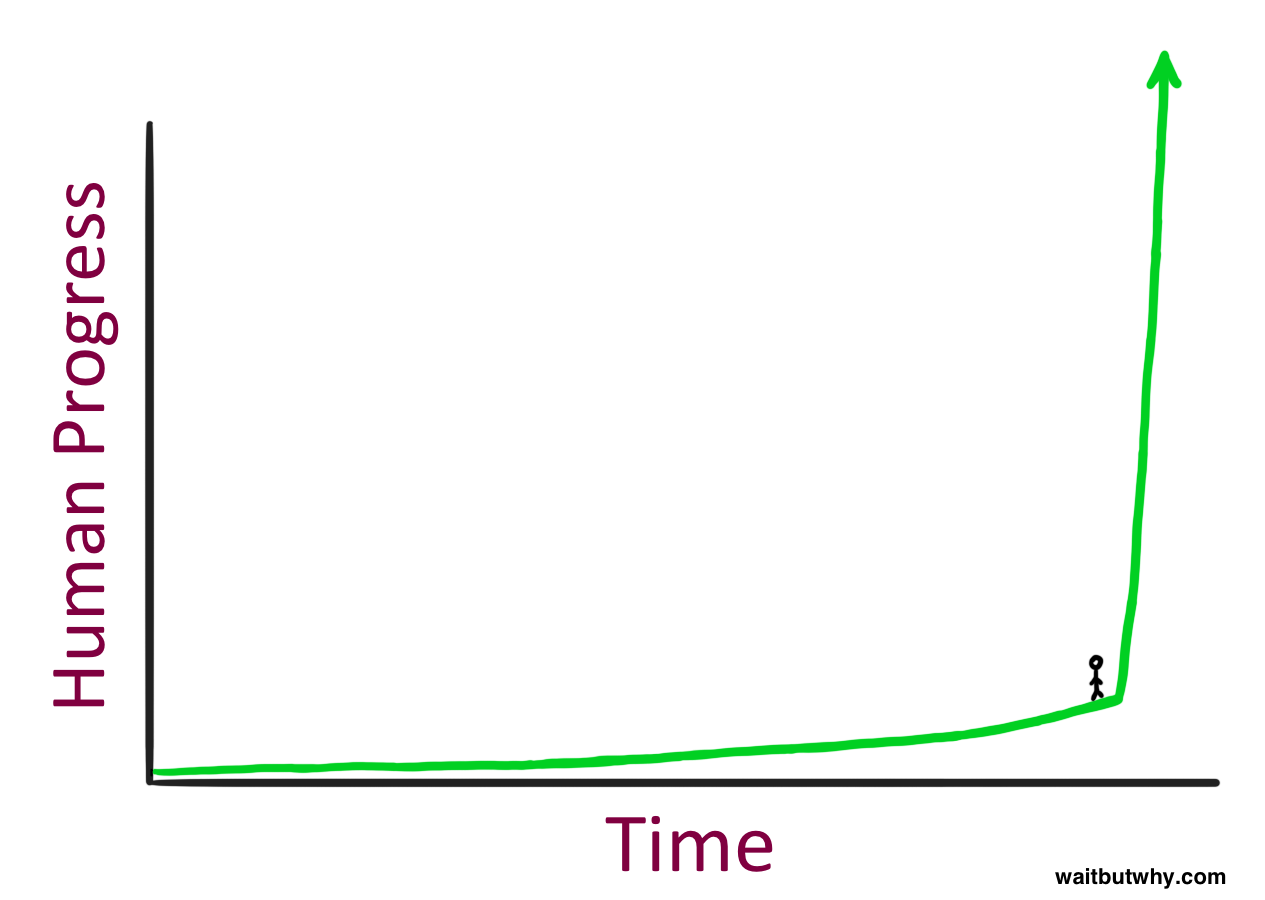
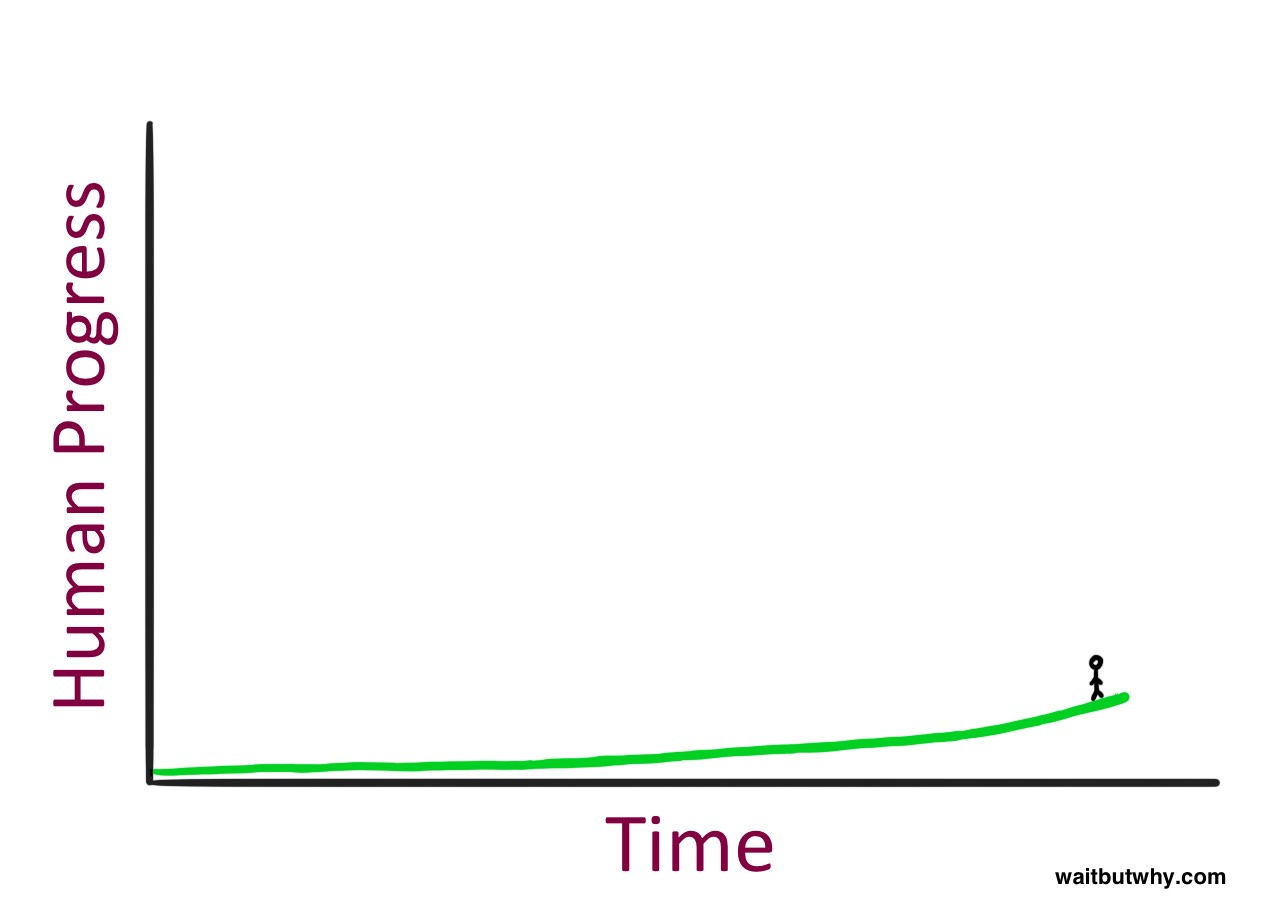
I highly recommend that you read Wait But Why's piece on artificial intelligence. In particular, the opening section on why we can’t picture the magnitude of changes coming in the future. It opens with a graph, and the question "What does it feel like to stand here?"


Edge1


"It seems like a pretty intense place to be standing—but then you have to remember something about what it’s like to stand on a time graph: you can’t see what’s to your right. So here’s how it actually feels to stand there:"


Edge


We have a growing body of evidence suggesting that change is occurring on an exponential scale, in several ways. And we can understand that idea rationally; we've pretty well internalized it.


"We have all heard this before, but constant change is the norm and the speed of change is staggering...

The complexity of the issues we face is also growing across all domains—fiscal, health, environment, security, diplomacy, development, defence, transportation, to name a few. "
- Janice Charette, Clerk of the Privy Council [source]


But, like the figure in that second graph, we tend to revert back to thinking that we can manage that level of change. The problem is that our brains are swapping one question for another without us knowing it. Instead of answering "Will the near future look very different from the present if we’re experiencing an exponential rate of change?" we're answering "Can I personally imagine the effects of exponential change on the near future?" and the answer is actually that no, we can’t. We tend to just mentally extend the trendline from the last few years.


How we deal with a largely unpredictable future merits much longer shrift. For another time.


Hyper-networked isn't special


In the earlier days of the digital (and particularly social) world, finding insights in other fields or sectors of the economy and being able to imagine them applying to government was a really useful skill.


The thing is, it no longer takes research or even much insight to recognize useful tools or credible change drivers. We can replace "Aha!" moments with mental shortcuts, and the way we find information provides cues about people's intelligence and authority. For instance, if X colleague and Y scientist reference Z person's idea, and we think X and Y are smart, we'll probably think Z is smart and the idea holds water. An extreme example would be when Stephen Hawking, Elon Musk, and Bill Gates warn about artificial intelligence. They're smart, and when other smart people agree with them, the idea is credible. It doesn't take any understanding of AI on our part to catch a glaring hint about its importance - all we've done is compare the claim against a mental rolodex of trusted sources. Search algorithms, human curation, and the existence of instructions for pretty much anything have hugely leveled this playing field.

It was easy to see Uber coming, but much harder to prepare for it. Which is why taxi drivers were still protesting in Ottawa yesterday.


The next big thing


So I’m left thinking that the Next Big Thing is that we get better at how we make sense of purported Next Big Things, and we get better at how we handle constant Big Things that we won’t really see coming. Which would mean we need to dig into and dissect the concepts of foresight, change management, adaptability, agility, resilience (agility and resilience being two very different things), and take them far, far more seriously.


*A quick note on future-focused posts: long before I joined the site, posts like this hugely impressed me: Signal to Noise. I still find those kinds of posts to be strong, and they seem to garner more interest:


Wednesday, 3 December 2014

On Prescriptions for the Public Service


by Kent AitkenRSS / cpsrenewalFacebook / cpsrenewalLinkedIn / Kent Aitkentwitter / kentdaitkengovloop / KentAitken


I'd like to propose a new litmus test for how we consider changes. I hinted at it last week (see: Influence, Organizations, and Team Players), when I said that there could be a divide between the advice I'd give the public service writ large and the advice I'd give an individual that I care about.

But that divide has been on my mind for a while, in the context of this blog as well as the general advice public servants have been getting from many sources:


Consider, for example, this graphic from Destination 2020:


Source


Which lays out the "work from anywhere at anytime" and "more flexible" public service envisioned for 2020.

From the external Public Policy Forum (albeit with much input from public servants), we hear that public service leaders must be persuasive entrepreneurs:

"...leaders need to be able to break down complex ideas and convince others of the best course of action, especially when unpopular policies are being proposed."

Shrewd diplomats:

"...leaders need to work with elected officials and their own teams to ensure that accountability measures do not undermine innovation, productivity, or talent management. They must respect the pressures facing government, but also focus on building a high-performing public service."

And fearless advisors:

"[Leaders need to do] the right thing, regardless of the consequences..."

And generally speaking, I'd agree with all of this advice. But I have to admit that the rubric changes when I shift from thinking the public service should do X, Y, and Z to imagining giving advice to a close friend, a sibling, or a child who has just joined the public service.

Would I tell them to push for flexible work arrangements or leeway to collaborate with stakeholders and colleagues? To push back on senior leaders, whether political or public servant, to do the right thing? Or, to be a team player, to bide their time, to not rock the boat?

I suspect we'd all find instances of advice that we'd offer to crowds, but not to close relations. Which is not to say that we're hypocrites or liars. Rather, that culture is a lumbering beast to turn; and that we're not done yet.

Friday, 10 October 2014

Why the Sharing Economy is Inevitable and We Need to Think Differently


by Kent AitkenRSS / cpsrenewalFacebook / cpsrenewalLinkedIn / Kent Aitkentwitter / kentdaitkengovloop / KentAitken


Last week Uber launched in Ottawa. It's a smartphone-based ridesharing platform that is structured more like a taxi-passenger relationship than a carpooling forum. Drivers got dinged with fines, Uber found workarounds, and we'll see where things stand once the dust settles.

Uber's one of many examples of the sharing economy, and it's one of the brands that has become a lightning rod for attention. For hospitality, it's Airbnb. Kijiji also fits this model, which is sometimes called collaborative consumption or the peer-to-peer economy.

Regardless of the virtues and problems people see in the sharing economy (often fairly, in both cases), here's why I think Uber and its ilk are inevitable, and why Uber is the latest in a long line of canaries in the coal mine for rethinking governance.


Information Asymmetry

Services like Airbnb, Uber, and Kijiji - connecting buyers and sellers, one-to-one - are all natural extensions of traditional markets. What we're learning is that this demand and supply always existed. What was missing was the ability to connect the two. The previous state of affairs should actually be considered a market failure: a inefficient allocation of resources resulting from people not having certain information available to others. At its simplest, "I need X" and "I have X". The digital age has started to fix this information asymmetry.

Pre-internet, hotels actually provided a significant informational service in addition to hospitality. Standards, chains, brands, prominent signage, Yellow Pages outreach, and marketing in tourism guides were all important for people looking to find a place to stay in a different city. So we paid a premium on rooms to compensate hotels for their work towards minimizing information asymmetry between sellers and buyers, which took the form of "We have rooms."

Another example might be banks. The old banks in our towns and cities are opulent, grandiose stone buildings, lined with pillars, laid with marble floors. Consumers paid a premium on interest not to create cushy offices for bankers, but for our own sense of confidence in banks, and in their reliability and permanence. Marble floors have a certain "We'll still be here next year" vibe to them, which was important for those storing their money.

Today, we can focus more so on the core value: a place to stay, money management, or transportation. Advertisement has somewhat gone from a foundational service to a differentiating factor, from the safety row of Maslow's hierarchy to the belonging, self-esteem, or self-actualization rows. That is, from "We have rooms" to "Here's the sort of person you'll be if you stay at our hotel instead of our competition's." The added value of a memorable phone number or a Yellow Pages presence has been leveled.


Weak Sustainability

The reason I think services like Airbnb and Uber are inevitable is that in the long term, it's actually a completely indefensible policy position to stop them.

Sustainability has become a loaded term, but stripped of its political connotations it simply means that an activity isn't destined to ruin by virtue of its own existence. That is, we can keep doing it. Even the cold economical view supports at least "weak" sustainability, or the maximization of value over time. The difference between this view and the environmentalist or "strong" sustainability view is that the former doesn't care whether this value comes from natural capital or man-made capital and technology. But both views have a common principle, which is using resources as efficiently as possible. If there is both demand and supply for additional uses of privately owned goods such as houses and vehicles, we'd be failing both economically and environmentally by artificially limiting that market-driven allocation.

Power tools are perhaps the good example here. A drill might get used for 20 minutes a year, yet every house on a street contains one. To bastardize a cliché: these people don't need drills, they need holes. What's emerging now is the sharing mechanism. The good news is that once the information asymmetry is fixed, the natural resources otherwise becoming drills will still get used, and the money otherwise paid for them will still get spent. Just in theoretically more efficient* ways.


Considerations

The two big curveballs introduced by the increasing prominence of services like Airbnb and Uber are taxation and regulation, the latter including consumer protection and safety. The economist lens might suggest that theoretically, buyers of these services have included those reliability, safety, and recourse risks in their decisions. In reality, we know that things are much more complicated than that.

I don't know the answer. Rather, I think that we should rephrase the question. Right now it's a composite of "Should we allow this?" and "How would we ensure tax revenues and consumer safety?" It needs to become "If this is a natural extension of the entire system on which our economy is built, what does that mean?"

(With, perhaps, a degree of empathy towards those whose livelihoods are reliant on the markets that are experiencing change.)

And it doesn't matter what proportion of a hospitality or transportation market peer-to-peer services consume. Small percentages of large markets, over long periods of time, turn into large absolute figures.


The Canary in the Coal Mine

Uber is a fascinating story because it didn't need to be a shock. An analogue of what happened in Ottawa with Uber last week has been happening in New York City for the last few years with Airbnb. Scrambling regulators, consumers with no clear guidance, providers fined as though by random chance, entrenched interests lobbying and crying the wolfest of wolves.

The pressing policy questions surrounding the sharing economy deserve attention. How does government react?

However, there are more interesting questions, considering Uber as a case study, not a standalone problem. How does government understand and internally amplify signals of change?


*Yes, I am aware of the irony. If you take a completely macro view of efficiency, those long-term investments referenced in my last post become efficient as well.

Wednesday, 17 September 2014

Change and Inertia

by Kent AitkenRSS / cpsrenewalFacebook / cpsrenewalLinkedIn / Kent Aitkentwitter / kentdaitkengovloop / KentAitken


One quick note: last night was the final event of Richard Pietro's Open Government Tour. Richard is a citizen who has been riding his motorcycle across Canada since July 2, speaking about Open Government, purely because he believes in it.


The motorcycle does indeed have "Open Data" and "Open Gov" decals. Richard was holding the camera for this one.

I just want to say congratulations to Richard and encourage you to check out that link - it's an inspiring display of creativity, drive (to the point of virtuous audacity), and civic engagement.


"Change is the new normal," I heard recently. True. But it's also the old normal. It's just what happens.

At this point in the post you can choose your own adventure: enjoy six minutes with Toronto CIO Rob Meikle on change and our attitudes towards it, or skip to the next paragraph.


The fascinating flipside to constant change is when we want to change, or when we're told to change, or when we're informed of change and... nothing really happens.

This could be personal habits, organizational pivots, or attempts to influence a community. It comes with some form of the message "This is what's going to happen, and this is what is needed from you."

But we get that message dozens of times a day. And without reinforcement, it sounds like noise. What's missing is the sustained commitment, the signalling that sets apart this particular change, and our day-to-day experience feeling different after that decision point. 

The world around us is changing, one shock after another. New technologies, new demands from citizens, new crises in governance, or in that which is governed. New demands on ourselves to constantly learn and adapt. Yet, in many ways things stay rock steady. The conversations have changed staggeringly in the last half decade, but the day-to-day experience is sometimes exactly the same.

We have to recognize that organizations and people have tremendous inertia, which is a reasonable approach to staying sane and filtering false signals about change. But when we really need to change, we need to stop approaching it like this:


A sudden effort, at one moment in time. No one can feel it.

Wednesday, 4 June 2014

In Between Disruption and Incrementalism


by Kent AitkenRSS / cpsrenewalFacebook / cpsrenewalLinkedIn / Kent Aitkentwitter / kentdaitkengovloop / KentAitken


In Tragedy in the Commons, Alison Loat and Michael MacMillan quote columnist Andrew Coyne:

"People often ask: how can we reform politics? And the answer is: we can’t. There are very few institutional changes that would do any good, and whatever would has no chance of being enacted."


I'd like to stress that I want to consider this quote as a reflection on institutions, which I think can stand quite separately from the context of the column in which it was written.

This hits on a truth about many institutions: the changes that make the most difference are unlikely, precisely because they're changes. And institutions are structured as they are because of the way things have been.

Coyne applied this to politics. It can apply equally to corporations, trade organizations, policy and legal environments, governance bodies, or bureaucracies. And it does not assume a priori that change is necessarily good. It's simply a feature for organizations, of any kind, for would-be changers to consider.

So I'd like to explore a thought experiment for those who are interested in change, but have watched others before them try and fail.


Snowball Policy

One common example of behavioural economics applies to retirement savings. When people are asked if they'd like to increase their savings rate today - through increased deductions to their paycheque - they pass. They'll increase it later, after they pay X off, when things are less tight, etc. However, when asked if they'd like to commit to increasing their savings rate in the future - same deduction to take-home pay, but synced up with their next pay raise - they sign up.

The principle is simple. We can be rational about our long-term good, but immediate, emotional, and visceral needs often supersede our rationality. So what's the institutional version of that approach to retirement savings, scaled up?

It's not committing to political reform for the next time an election is called, and it's not committing to governance changes for the next time a CEO retires. Such systems are vastly more complex than even retirement savings.

The deck is stacked against anyone simply volunteering to dramatically alter the institutions they control. At the very least, it's uncertain, it's change. But it seems that many players would agree to future commitments: an algorithm, a series of if, then statements that would improve institutions, level the playing field, and leave a legacy. Especially when it's hard to predict which side of the playing field one will be on in the future.


A Thought Experiment

Take an idea like proportional representation for voting, where (in one form or another) parties gain numbers of seats based on popular vote. It's complex, a major change from the status quo, incredibly contentious, and almost certainly fits Coyne's assessment of "no chance of being enacted." That is, if a motion was to introduce legislation establishing proportional representation. What if, instead, a motion was made to introduce legislation that required parliament to do the following? (Excuse the sheer volume of variables, denoted by capital letters.)

"If voting rates were below a certain threshold in year A, form a committee of B nature to provide C number of options on electoral reform including some form of D, E, and F, and if G level of public consultation led to H result, a public referendum would be held and if I percentage of the Canadian population agreed, parliament would hold a binding vote of J nature."

Convoluted, yes, but I'm trying to draw as extreme a thought experiment as possible. Regardless, it strikes me as more likely of enactment than a straight call for a vote. And if the principle is sound, then it's really a question of degree. What's the balance of reliability, effectiveness, and distance into the future that people will actually agree to? That's the key. Great ideas with a snowball's chance in hell of success are not great ideas.

There are examples of governance through this mechanism. Consider radio spectrum auctions. These are characterized by well-entrenched interests, massive stakes in potential profits, and complex institutions. Yet, all the players agree to a complex set of conditions for future decision making and (generally) abide by them, which can maximize both fairness and public good. This isn't out of reach. It's the social contract, the legitimacy of democracy, scaled down.

Typically we consider our options for change as disruption or incrementalism. A third option has always existed, which is stealth: a disruptive plan masquerading as incremental. System consensus - in which actors agree to the conditions and systems of future decision-making, without necessarily agreeing to the decisions made - strikes me as a fourth option ripe for additional exploration.


Within the Public Service

I used a massively thorny, nation-wide concept for the thought experiment. I'd also see it as the most likely solution to persistent trust gaps (see: Risk, Failure, and Honesty and On the Trust Gap). However, I think this could apply throughout any organization.

The most likely arena for this approach to change would be where bureaucrats and elected officials intersect, in the advice and options put forth to Cabinet on big-P Policy. But here's a smaller example: the fall 2013 Policy Ignite session, in which public servants pitched innovative policy ideas to a Dragon's Den of senior executives. The executives then further explored the top pitches - which suddenly makes them responsible for the ideas.

Consider, instead, if the rule had steadfastly been that the top ideas would get piloted as presented. In this scenario, those executives are responsible for the decision to hold the competition but less so for the outcome of the pilot. Obviously there'd have to be other parameters built in, but this approach could in many ways provide the more stable platform for experimentation and testing unconventional ideas.

The question is still defining the problem, then considering all of the tools at one's disposal. But this could be one to consider adding. Maybe disruption will work, maybe the slow and steady approach, or maybe, asking for a commitment to a long-term future.

Wednesday, 23 April 2014

Pilot Projects and Problems

by Kent AitkenRSS / cpsrenewalFacebook / cpsrenewalLinkedIn / Kent Aitkentwitter / kentdaitkengovloop / KentAitken

Earlier this month the Director of the MaRS Solutions Lab, Joeri van den Steenhoven, spoke in Ottawa about Systems Change. The Systems Change idea is that to solve Canada’s complex problems, we not only have to create new solutions but alter the systems in which we develop and implement solutions in the first place. 

There was much to dig into from Steenhoven’s talk, but for today I want to point to a statement he made about pilot projects. His idea was that while we dutifully test out ideas -  we being social entrepreneurs, businesses, municipalities, provinces, or the federal government - we rarely maximize or scale what we learn through those pilots.

I’m sure we could make a long list of why that is, but I've had three factors in mind lately: the We’re Special syndrome, False Negatives, and False Positives.


We’re Special

Here, organizations neglect to look for, or take advantage of, the lessons of previous pilot projects or programs on the basis that their environment, organization, or challenge is fundamentally different. Or because they mistakenly believe that they’re the first to work in a particular problem space (hat tip).

Every organization is unique, yes, so other organizations’ lessons learned may only provide a rough guide, or principles and parameters, for a pilot project. But very few organizations are downright special. Exceptionally talented people are prone to error and bias, and few solutions are entirely novel (“All art is either plagiarism or revolution.” - Paul Gauguin). So those principles and parameters are invaluable starting points.


False Negatives

Any pilot that is launched without the requisite resources, time horizon, provisions for adjustment, or level of understanding will almost certainly get chalked up as a failure. A pilot project will likely be a pretty rough draft of the hypothetical full-scale program; pilots are new to the team executing them, exempt from economies of scale, and have fewer collaborators who can spread continuous improvements.

So, that game-changing idea that needs buy-in? It’s going to get approved or rejected based on the single worst version of it that anyone ever sees. Here is where a genuine understanding must support metrics, especially when it may be difficult to set them meaningfully. What of the experiment was meaningful, and what wasn’t? Were shortcomings because of the concept? Or the design, resourcing, or execution?


False Positives

Occasionally pilot projects fail to lead to meaningful organizational learning because of false positives. As with false negatives, it’s hard to set metrics for a project that has never been done and is not well understood. So, one of the easy mental baselines is zero: that is, before the pilot, nothing happened; during the pilot, something happened. Ergo, it was a success.

The real standard should be what would have been possible had the pilot project been done very well, and establishing that standard is only possible by employing the defence mechanisms against problems #1 and #2, above: establishing parameters by understanding comparable projects done elsewhere, and building as complete of an understanding of the environment as possible.

The false positive problem leaves ideas in a dangerous middle ground, with just enough success to avoid adjusting the approach, never revealing the true potential.


Processes, not Projects

Last year Tariq Piracha wrote about thinking about change systemically (see: Change is a Process, not a Pilot). He suggested getting away from the traditional pilot project model for approaching change within organizations. Which is the core of van den Steenhoven’s talk: if our current system for testing concepts is flawed, how do we create a better system in the first place?